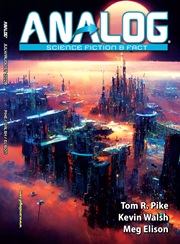
 Analog, July/August 2026
“Red Ships” by Tom R. Pike
“Casual Brutality” by Michael T. Kuester
“The Elegant Test” by David Horn
“Dead God’s Algorithm” by Auston Habershaw
“Variables In the Drake Equation” by William Preston
“Sightseers” by Nikolai Lofving Hersfeldt
“Disaster Relief” by Jennifer R. Povey
“And Her Bones Made the Hills” by Mel Hubahib Lona
“Falling” by Jen Downes
“The Eemian” by J. A. Schultz
“Churn” by Andrew Dana Hudson
“The End of the Line” by William Paul Jones
“The Inheritance” by Alyssa Abigail Aquino
“A Sky for the End of the World” by Gregor Hartmann
“Conversations with Callie, or the Synthesis of Love and Disdain” by Lettie Prell
“Go Forth and Multiply” by Meg Elison
Reviewed by Mina
My favourite tales contained good old-fashioned tension and some basic humanity. This was a good issue but I need to overdose on Disney cartoons now.
“Red Ships” by Tom R. Pike could be called “beware of outworlders from Ares bearing gifts.” The planet’s (Recife) ruling dynasty becomes a pawn for the race that arrives on the red ships. It was a cynical tale of political intrigue, but it didn’t offer anything very original.
“Casual Brutality” by Michael T. Kuester introduces us to a grizzled detective in space. He and his partner are investigating space pirates who disable ships, steal their fuel and oxygen, then jettison crew and passengers into space. They also have a young, idealistic trainee with them. It’s a gripping story on more than one level, as it’s also an analysis of the psychological effects of space life. It asks the question—can someone’s basic humanity survive it? I enjoyed the comment that an AI trained by a crook is better at finding crooks.
“The Elegant Test” by David Horn is a short story where Jules Verne meets biochemistry. I must admit that the biochemistry was beyond me, but I did enjoy the good old-fashioned tension. Can two scientists prove that a mineral sample under the ice on Europa can breathe before the storm from Jupiter hits the sub? Can the sub’s pilot get them out alive? It was a lovely mix of science and adventure.
There are some beautiful black and white illustrations at the beginning of this story.
“Dead God’s Algorithm” by Auston Habershaw looks at a non-benevolent AI trying to take over the universe planet by planet (the Bodani Collective). A benevolent race (The Listeners) send a shape-shifter to stop the Bodani from succeeding on a planet of sentient frogs.
There is humour in this story and a clever plot but I wasn’t a fan of the callousness shown by the “saviour,” making them no better than the enemy really. Still, their amorality did reflect my experiences of members of the special forces I have met in my life, so… accurate?
“Variables In the Drake Equation” by William Preston is, on the surface, a look at the variables for proving the likelihood of intelligent life in the universe. Underneath that, it’s about friendship, how we can lose track of friends and how some of us are like shooting stars: we shine bright, but if you blink, we’re gone. The story ends on a melancholy note, but the headings take on a new meaning when you look back at them. Loss is very much about lost opportunities—that big full stop, our conversation ends here.
“Sightseers” by Nikolai Lofving Hersfeldt is cheerless. A race of immortals watch as a world beneath their spaceship destroys itself in a nuclear war. All of them had lived on the planet for a while to get the full experience. None seem to feel anything for the dying world and its inhabitants. They get drunk whilst watching the light show below. A comment on the media and its voyeuristic audience?
In “Disaster Relief” by Jennifer R. Povey, we follow the narrator after an earthquake wipes out a lot of Memphis and the surrounding area. They deliver computers, SIM cards and a server. Then they roll up their sleeves and help to move dirt. It’s a plea for true community action in a world that can’t trust its government to be there for them.
“And Her Bones Made the Hills” by Mel Hubahib Lona may not be your thing as it’s very poetic. But I enjoyed it thoroughly. You have to read slowly for the tale to unfold properly. It tells of the love between a motherbird unit and a terraformer. And their ultimate sacrifice when preparing a new world for the children.
“Falling” by Jen Downes is a gripping tale. Lina is coming to the end of her four-year contract on a production platform in orbit around Jupiter. But then an atmospheric miner suddenly fails and starts falling towards Jupiter. Lina risks her life to save the ship, so as not to have the corporation turn her into the scapegoat, and to win a bonus that will allow her to go home to her husband and son at the end of her contract. Will she make it back alive?
“The Eemian” by J. A. Schultz looks at what if there was another civilisation on Earth in an interglacial period between 130,000 and 115,000 years ago? Would there be any evidence left of it? Bradley begins the research into an organic satellite found in orbit, later joined willingly by his wife and reluctantly by his daughter. A nice thought experiment, kept just human enough.
“Churn” by Andrew Dana Hudson takes patience to read. It does turn out to be worth it, so hold on. Pitt lives in a society where, every year, people vote for the next communications platform or device after the churn. He marries and has a child but does not hold onto friends through each churn. His wife and daughter decide to move to a stablezone and Pitt reacts badly. It takes him till much later in life to work out what truly matters.
“The End of the Line” by William Paul Jones posits a restaurant above the Earth. In it, two politicians have a confrontation over food. The restaurant staff may be invisible to the politicians but they are not powerless. The parallels with world politics are very clear and the conclusion quite satisfying. A nice twist on the idea of a last meal.
“The Inheritance” by Alyssa Abigail Aquino is psychologically complex, which I always enjoy. Mila gets a golden ticket to the Martian colony due to her mother pulling strings. She has a complicated relationship with her mother, who has been instrumental in the terraforming on Mars but abandoned her in her early teens. She has a good idea about what life is like in the Martian colony, since she visited it as a teenager. We follow her last few days on Earth. Despite all the problems (there are hints about climate change), can she leave all the things she loves behind?
“A Sky for the End of the World” by Gregor Hartmann is set on a planet named Gaia (clearly a future Earth). We have a two-tier society: ChoRen and Sap (echoes of Gattaca?). The scientist Korsgaard has to convince the ruling class that the Flare Protection Group’s work is essential. The world building is well done—it feels like a mix of influences, but there is enough that is new to make it interesting. And it’s well written.
The novelette “Conversations with Callie, or the Synthesis of Love and Disdain” by Lettie Prell invents the word “instantiation.” A couple agree to have their dying daughter instantiated, her brain imprinted into computers. Callie develops rapidly in her new form—becoming post-human, transhuman or compu-human, as she calls it. Her father interviews her for a documentary, then continues to speak with her regularly. Her mother moves on, no longer recognising her daughter in her new form. The end brought a lump to my throat and I will never think of the word “whoosh” in the same way again.
My only quibble is with the title—I dislike it intensely when authors give two titles. I would urge, decide on the effect you want to have on your reader, then choose that title. I assume the author isn’t aiming for a reader to skip their tale because the only effect of their title is irritation and worry that it’s just going to be too pretentious for words?
“Go Forth and Multiply” by Meg Elison is very good. There’s a moment when it gets too preachy but I can forgive it that (I am definitely for “showing rather than telling” in a story). Imagine losing your seven-year-old son and getting a clone one year later. A clone you planned. But due to an error, you suddenly find yourself with two extras, one of them a girl. The mother and father react very differently to this situation—Theo was such a loving and accepting character, and so much SF is missing that basic human warmth. That said, I can’t imagine the sort of freedom being a millionaire gives you.
I particularly enjoyed the line: “We got screwed by a corporation… that’s just life as an American, isn’t it?”