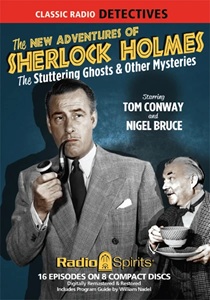
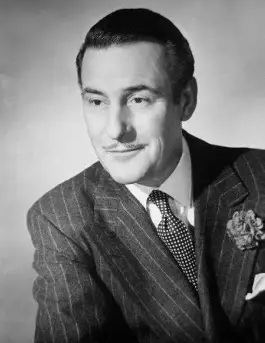
 The New Adventures of Sherlock Holmes (1939-1947) aired “The Singular Affair of the Coptic Compass” on Dec. 7, 1946. This is the 22nd Holmes episode since our first in 2013 and only the 2nd since April of 2024, two and a half years ago, so I thought it was time for another. During this incarnation of Sherlock Holmes on radio (the first coming in the early 1930s and the last running to 1959), Basil Rathbone (1892-1967) and Nigel Bruce (1895-1953) reprised their Universal studio film roles of Sherlock Holmes and Dr. Watson for close to 220 episodes. Afraid of being typecast–-and following the cancellation of further Holmes films–-Rathbone wanted out of his radio role. Though the show’s sponsor at the time, Petri Wines, offered him a generous bump in compensation if he would continue, Rathbone declined. Following his final episode as Holmes at the end of May 1946, the Holmes character was played by popular British actor Tom Conway (1904-1967, photo top right) who was an excellent Holmes, with Bruce staying on until the series end in July of 1947. For several years (from September 1945–July 1947) scripts were written by the team of future F&SF co-founder Anthony Boucher and Denis Green. Boucher, a diehard Holmes fan, would pen the outlines of scripts and Green would supply the details. They worked well together and the show flourished.
Fans of The Falcon film franchise will remember that Tom Conway played the title role in nine Falcon films from 1942-46, after taking over the role from his brother, actor George Sanders. So as not to confuse the public with their same last name in film credits, George and Tom flipped a coin and George won, retaining the original family name, with Tom adopting the last name of Conway.
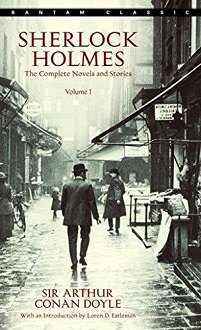 Since close to 140 years (as of 2026) have passed since the first story of Sherlock Holmes and Dr. John Watson appeared in Beeton’s Christmas Annual magazine for December 1887 (A Study in Scarlet), much has been written, filmed, or dramatized of the most famous sleuth on the planet. In fact, the Wikipedia page devoted to Holmes, states that the Guinness Book of World Records’ lists the Holmes character as “the ‘most portrayed movie character in history’ with more than 70 actors playing the part in over 200 films.” And while hardly all inclusive, Wikipedia notes that those writing Holmes pastiches number the likes of Anthony Burgess, Neil Gaiman, Dorothy B. Hughes, Stephen King, Tanith Lee, A. A. Milne, and P. G. Wodehouse–to which I will add Manly Wade Wellman, Philip Jose Farmer, James Lovegrove, George Mann, Kim Newman, and Fred Saberhagen. It’s a sure bet there have been many others of genre interest over the years who have tried their hand at a Sherlock Holmes novel as well.
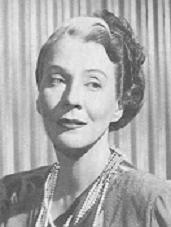 Sherlock Holmes first came to radio solely because of the tireless efforts of one remarkable woman. Edith Meiser (1898-1993) first brought Arthur Conan Doyle’s legendary sleuth to radio in 1930. She would write the scripts based on Holmes’s original adventures for the next 12 years, sometimes branching out to pen tales in the Holmes tradition. Meiser was beloved of Sherlock Holmes fans and members of the Baker Street Irregulars (BSI), but until 1991 the BSI was a male-only organization. However, in part to rectify this situation she was welcomed into the Adventuresses of Sherlock Holmes (ASH), originally an all-female Sherlock Holmes club, though it would later open its doors and become co-ed. The day every year that the BSI would hold its annual dinner, so too would the ASH, with Edith Meiser as its Guest of Honor. During the 1950s Meiser also wrote a daily Holmes comic strip, and was considered a great Broadway actress who also starred in films and early television, including appearances on I Love Lucy. One of the great unsung heroines of early radio (to the outside world at least), she died in 1993.
“The Singular Affair of the Coptic Compass” proves that Sherlock Holmes’ arch enemy Professor Moriarty will stop at nothing to show his intellectual superiority over Holmes. Setting the stage by making an early appearance in this episode, Moriarty has set several seemingly unrelated clues about the body of a naked corpse he has left in the middle of Holmes’ apartment, of all places. Among the clues are a coptic compass, a half-eaten apple, and a set of clothes not those of the corpse. Holmes’ deductive powers are at their finest here, observing the tiniest bits of information hidden to us mere mortals that, when pieced together, somehow point to Moriarty as the culprit. But the next question becomes the reason behind what Holmes has deduced as Moriarty’s obvious deception, as his real plan has now become clear, that he wants the world’s greatest detective spending time on a wild goose chase in order that his true crime in the making is able to proceed without interference from Holmes. When Holmes and Watson come to the realization that Moriarty is up to something on a larger scale than several puzzling clues topped with a naked corpse to occupy their time, just what it is and how they defeat this newest example of the twisted genius of Professor Moriarty begins, as always, with Watson as he relates the tale of “The Singular Affair of the Coptic Compass” to his usual visitor who arrives to hear Watson’s continuing exploits of the immortal Sherlock Holmes.
(The CD linked above contains this episode and 15 others, all remastered and restored.)
Play Time: 29:19
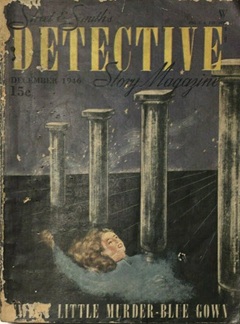
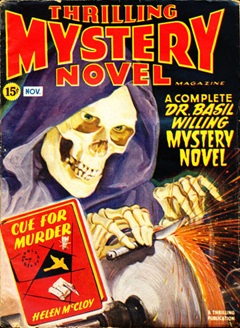
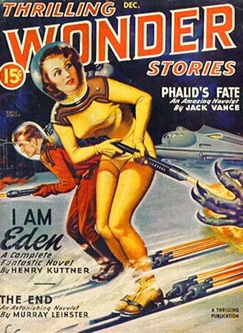
{This episode of The New Adventures of Sherlock Holmes aired at 9:30 PM on a Saturday evening in early December of 1946. The neighborhood gang was at the corner newsstand the next day after church to discover more exciting detective (or adventure) fare from some of their favorite pulps. Street & Smith’s Detective Story Magazine (1915-53) was the first pulp devoted to detective fiction. It was a monthly in 1946. Thrilling Mystery Novel Magazine (1935-51) started out as a weird menace title, but in the 1940s began to shift its emphasis to more traditional mystery fare. 1946 saw 5 issues, some bimonthly and one a quarterly. The issue shown below was its final offering for 1946. Thrilling Winder Stories (1936-55) was one of the most beloved SF pulps of them all, along with Startling Stories and Planet Stories. All three featured colorful, action-oriented stories set on other worlds, with little interest in scientific accuracy which fell by the wayside when it came to exotic planetary landscapes, Bug Eyed Monsters, scantily-clad damsels in distress, and evil villains of all sorts. It was a quarterly in 1946 but did manage to squeeze in a 5th issue, the one shown below, as the first of its new bimonthly issues.}
[Left: Detective Story, 12/46 – Center: Thrilling Mystery Novel, 11/46 – Right: Thrilling Wonder Stories, 12/46]
To view the entire list of weekly Old Time Radio episodes at Tangent Online, click here.