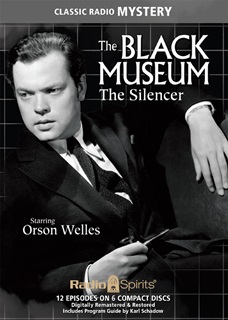
 The Black Museum. A Repository of Death. Here in the grim stone structure on the Thames which houses Scotland Yard is a warehouse of homicide, where everyday objects . . . all are touched by murder.”
The Black Museum (1952) aired “The Silencer” (in the United States and as near as historians can reasonably ascertain) on October 7, 1952, as the 41st of the show’s 51 episodes. This is the 13th episode we’ve run of the show since the first in 2018, with the last coming in June of last year, so as usual a bit of background is in order for newcomers to this sometimes grisly program. First of all, the name the Black Museum was coined in 1877 by a reporter for London’s The Observer newspaper, though the museum had opened in 1875 with the official name of simply the Crime Museum. It is the oldest museum in the world to display only artifacts of crime and is still known today by its official name of the Crime Museum despite the more colorful name given it by The Observer. The museum is not open to the public and is used primarily for instructional purposes for police training, but has had special visitors the likes of Sir Arthur Conan Doyle.
The Black Museum was one of four similar shows produced by Harry Alan Towers (1920-2009) under his Towers of London label in the late 1940s and early 1950s. Towers, a native born Britisher, would also produce popular radio fare like Secrets of Scotland Yard, Fabian of the Yard, and WHItehall 1212. All four shows centered around stories from the files of Scotland Yard, and New Scotland Yard’s famous Crime Museum, which was popularized in crime novels as the Black Museum. While all but Fabian of the Yard are verified as being produced and syndicated in Britain for future syndication, it is interesting to note that, according to the Digital Deli Too website entry, “WHItehall 1212 was a National Broadcasting Corporation production written by Lights Out’s famous scriptwriter Wyllis Cooper….” Three of the four shows, The Black Museum among them, would wrap their stories around an artifact from the museum, recounting in dramatic form the infamous crime associated with said artifact. Secrets of Scotland Yard kept to historical facts quite closely, and while a fascinating listen and quite popular, didn’t have the flair or melodramatic effect the likes of Orson Welles (1915-1985) would bring to The Black Museum as the host and narrator of each of its 51 episodes. And while The Black Museum also kept to the historical record surrounding each case, it would play a little fast and loose with them (or perhaps embellish them is the proper word) for dramatic effect, and it didn’t hurt that the show–-unlike the others–-drew its material solely from murders, thus guaranteeing the audience a chilling half hour. Overlay the grim stories with the somber, virtually hypnotic tones of Orson Welles and you’ve got a winner.
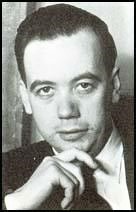
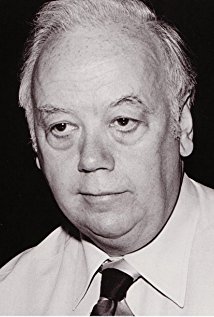 Speaking of Orson Welles, one might be given to wonder how he came to write some of, and host and narrate all of the episodes of The Black Museum, which were produced in the UK. It seems that Welles decided to take an extended “vacation” in England due to several professional and personal problems, including some “requests” from the Internal Revenue Service. So the American loss turned into Harry Alan Towers’s gain (Towers’s photo at left 1948, at right circa 1984), and he set Welles to work, a profitable solution for both parties. Welles would also work on two other Towers productions, perhaps the most well known to the American radio audience being The Lives of Harry Lime (or The Third Man.) The Third Man was a 1949 film noir British production set in post-World War II Vienna, with Welles playing the Lime character. Written by Graham Greene, it has attained classic status for its stylish portrayal of a decaying and corrupt Vienna, so Towers was striking while the iron was hot and rode the coattails of the film with Welles starring in the radio adaptation.
The airing of The Black Museum episodes presents problems for historians. Produced in 1950, it was first aired as a “pirate broadcast” by Radio Luxembourg, and then throughout Europe. It was eventually licensed by MGM Radio Attractions and ran in the United States under the Mutual Broadcasting System (MBS). MGM hand-picked what it considered to be the best 39 of the original 51 episodes and ran them from January 1, 1952 through December 30, 1952 (with a three month hiatus while a summer replacement filled the gap).There’s more to the odd packaging and eventual airing of select episodes of The Black Museum (Canada’s CBC radio would also purchase some 38-39 episodes and air them at different times than the American run, for but one example), but all of that is neither here nor there for our current purposes.
“The Silencer” portrays an all too familiar scenario and one of the most dreaded by any police force in the world. The basic story goes as follows and not much more need be added. A sniper using a rifle fitted with a silencer and capable of long-distance accuracy is murdering people apparently at random. Scotland Yard must act quickly, with little to no clues to go on, to stop the wanton executions. As you can imagine, this is a tense little thriller, made even more so by the utterly hypnotic voice of Orson Welles.
(The CD linked at top includes this episode and 11 others, all digitally remastered on 6 CDs, and features a program guide by old time radio historian and friend to this weekly Tangent feature, Karl Schadow.)
Play Time: 27:53
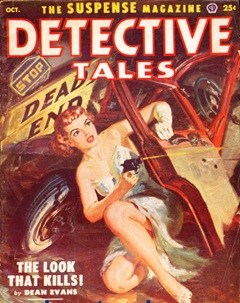
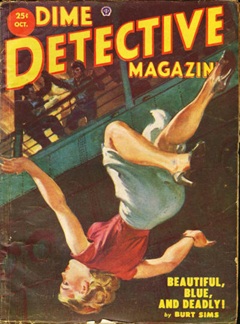
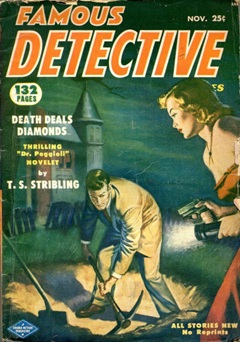
{“The Silencer” aired on a Tuesday evening in early October of 1952. That’s all the neighborhood gang needed for inspiration as they headed to their local newsstand after school the next afternoon. Detective Tales (1935-53) had a great run of 18 years and 202 issues. For all but its last three years it was a monthly. Dime Detective (1931-53) was the most profitable of Popular Publications line of detective magazines. It ran for a whopping 274 issues with the vast majority being monthly. Its last three years it cut back to a bimonthly schedule, including the October 1952 issue shown below. Famous Detective Stories (1938-57) was the 7th title of 8 of this detective pulp that began as Detective Yarns in June of 1938 and would eventually end up with its 8th title being Crack Detective and Mystery Stories for its last 4 issues. Under its 1952 title, Famous Detective Stories (June 1950–October 1956), it was a quarterly.}
[Left: Detective Tales, 10/52 – Center: Dime Detective, 10/52 – Right: Famous Detective, 11/52]
To view the entire list of weekly Old Time Radio episodes at Tangent Online, click here.