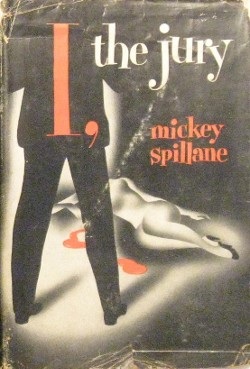
 That Hammer Guy (Jan. 1953-Oct. 1954) aired “Sophisticated Lady” on April 7, 1953 as the 14th of its 77 episodes. This is the first episode of the show we have run. The title of the radio show refers to Mickey Spillane’s classic detective Mike Hammer, who Spillane introduced to us in his 1947 novel I, the Jury. The combined total sales of the hardcover in 1947 and then the paperback in 1948 totaled around 6 1/2 million copies in just the United States. He has been labeled the “king of pulp fiction,” with estimated sales of his 26 novels (13 of which are Hammer novels) selling somewhere between 100 and 200 million copies.
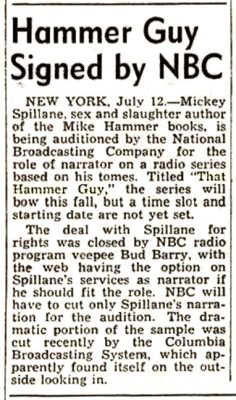 Mickey Spillane (1918-2006, photo top right) was born Frank Morrison Spillane. Born in Brooklyn, New York to an Irish bartender father, he served in World War II as an Army fighter pilot. About his early Hammer novels several critics panned them thoroughly. One called Hammer “a homicidal paranoiac,” while other critics called the writing “atrocious” and “nauseating.” Spillane went beyond the hard-boiled noir characters of Hammett (Sam Spade) and Chandler (Philip Marlowe) with Mike Hammer, who fell more in line with Clint Eastwood’s Dirty Harry film character, often seeming to take justice into his own hands due to a distrust of the judicial system. More often than not, any bad guy facing Hammer, if not shot outright, was found wretching from powerful body blows to the midsection. But it was Spillane’s ability to pen fast action scenes, something one recent critic claimed that Ross Macdonald and Raymond Chandler never could, that helped sell his authentic style of writing. Much of the tough language and situations in a Mike Hammer novel were not in line with the conservative morality of the period (the late 1940s through the 1950s), so was toned down appreciably for the radio series, as well as for the TV versions many years later.
 Mike Hammer became such an iconic and beloved detective, despite his literary critics, that the character spawned spinoffs in several media. There were five feature films including two of I, the Jury (1953 & 1982), Kiss Me Deadly (1955), My Gun is Quick (1957), and The Girl Hunters (1963). Many remember Mike Hammer from his numerous TV incarnations, all starring probably the most memorable Hammer of them all, Stacy Keach (1941– , photo at right). Mickey Spillane’s Mike Hammer ran from January 1984–January 1985, The New Mike Hammer continued his adventures from September 1986–May 1987, with the final iteration debuting a decade later with Mike Hammer, Private Eye, which ran from September 1997–June 1998.
According to wikipedia: “In 1983, Spillane received the lifetime achievement award from the Private Eye Writers of America. He also received an Edgar Allan Poe Grand Master Award in 1995.” He passed away from pancreatic cancer on July 17, 2006.
“Sophisticated Lady” opens with Hammer crashing in a fleabag hotel and being shot within the first minute of the story. Answering a knock on his hotel room door, the only thing Hammer remembers is a pair of brown and white saddle shoes and the shot that knocks him down but luckily only grazes his side before his assailant disappears. Working backwards from almost no viable clues, Hammer must track down his would-be killer and discover why he was targeted for death. Following a loose, piecemeal set of possible clues that may or may not even be connected, he eventually stumbles upon certain characters involved in their own dangerous matrix of deceit and murder, with an outcome even he doesn’t see coming. The only thread emerging through this oddly constructed story is a certain “Sophisticated Lady.”
Play Time: 28:54
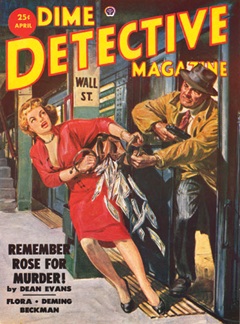
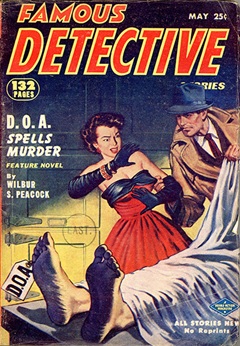
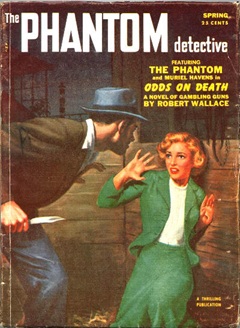
{Airing on a Tuesday evening in early April of 1953, the neighborhood gang was ready for more hard-nosed action of the sort they’d enjoyed in the Mike Hammer episode the night before, so after school the next day they headed for the nearby bookstore to bring some home. Dime Detective (1931-53) was one of the most popular and longest running of the detective pulps, showing up in newsstands and bookstores for 274 issues, almost all on a monthly basis. As it wound down, it became a bimonthly for 1951 and 1952, ending its run as a quarterly in 1953. The April issue shown below was the third to last, the August issue signaling its final farewell. Famous Detective Stories (1938-57) was the 7th of 8 titles the magazine sported over its unusual lifespan, the first being Detective Yarns in 1938 and the last being Crack Detective and Mystery Stories in 1957. It too was a quarterly in 1953. The Phantom Detective (1933-53) was Standard Magazine’s answer to Street & Smith’s highly popular The Shadow pulp. A source I regularly visit notes that it didn’t come close to publishing as many issues (175 to 325) as did The Shadow due to its less frequent publishing schedule, but lasting for over 20 years made it the longest-running single-character pulp in history. As with the other pair of detective pulps this time around, it was a quarterly but managed only three issues in 1953, the issue below being its penultimate offering.}
[Left: Dime Detective, 4/53 – Center: Famous Detective Stories, 5/53 – Right: The Phantom Detective, Spring/53]
To view the entire list of weekly Old Time Radio episodes at Tangent Online, click here.