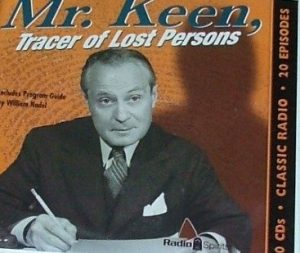
 Mr. Keen, Tracer of Lost Persons (1937-1955) aired “The Case of the Man Who Invented Death” on October 6, 1949 as the 1,259th of its 1,690 episodes. This is only the 4th episode of Mr. Keen we have offered, the first two coming in January and June of 2024 and the 3rd coming almost a year and a half ago in February of 2025. A reprise of the introductory material from those earlier shows is in order for newcomers, as well as for those familiar with the show who may need a quick reminder of the show’s basic concept.
The program was the brainchild of, and produced by the team of Frank and Anne Hummert, who were inspired by the 1906 novel The Tracer of Lost Persons by American author and artist Robert W. Chambers.
Mr. Keen, Tracer of Lost Persons holds the distinction of being the longest running of any detective show on radio, with its 1,690 broadcasts far outstripping its fellow detective shows, including (according to wikipedia): “Nick Carter, Master Detective (726 broadcasts), The Adventures of Sherlock Holmes (657) and The Adventures of the Falcon (473).” Unfortunately, out of the almost 1,700 episodes over its 18-year run, fewer than 60 shows have survived.
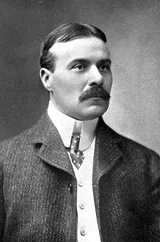
Bennett Kilpack (1883-1962, photo top right) starred as Mr. Keen, who came to be known as “the kindly old investigator,” and Jim Kelly would play the role of Keen’s Irish partner Mike Clancy. From 1937-1942 the NBC network aired the show three times a week in short 15-minute episodes, and true to the show’s name involved Mr. Keen tracking down people who had disappeared for one reason or another and had left families, homes, or jobs behind. In November of 1943 (and now with the CBS radio network since 1942) the format changed to full half hour shows, and Mr. Keen’s skills were expanded to include those of a full-fledged investigator, one who used his intellect and cunning not only to find missing persons, but to bring murderers to justice as well. Kilpack played Keen for nearly 1,300 episodes for 13 years, at which time he made his final appearance on October 26, 1950. Following his “retirement” from the show (its 1,314th broadcast), Mr. Keen would be played by Arthur Hughes and Phil Clarke, with the program’s final episode airing on April 19, 1955. While the show absorbed and survived criticism in some quarters for being written to a very broad-based (i.e., lowest common denominator) audience, it enthralled such a large swath of the listening public on a regular basis, providing it with much needed relief from the day to day grind, that it lasted for nearly 20 years, even unto the dawn of the television age.
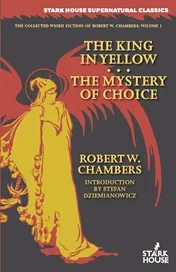 Before teasing this week’s episode, I’d like to give a nod to the author of the book who gave inspiration to the Hummett’s for Mr. Keen, Tracer of Lost Persons. Robert W. Chambers (1865-1933) was a prolific author who wrote dozens of novels, short stories, more than a handful of children’s books, and whose stories of his own work were collected in several volumes, with a number of his detective and/or supernatural tales reprinted in numerous anthologies. Chambers’ most famous work for fans of the fantasy genre is perhaps his 1895 collection of 9 stories, The King in Yellow. His wikipedia page provides the following paragraph of this singular work: “The book contains nine short stories and a sequence of poems; while the first stories belong to the genres of supernatural horror and weird fiction, The King in Yellow progressively transitions towards a more light-hearted tone, ending with romantic stories devoid of horror or supernatural elements. The horror stories are highly esteemed, and it has been described by critics such as E. F. Bleiler and T. E. D. Klein as a classic in the field of the supernatural. Lin Carter called it ‘an absolute masterpiece, probably the single greatest book of weird fantasy written in this country between the death of Poe and the rise of Lovecraft,’ and it was an influence on Lovecraft himself.”
This week’s tale takes us to a shabby boarding house in New York City and an eccentric inventor, found dead in his second floor room by a long time friend and fellow inventor. At first glance the police believe the inventor has been electrocuted by some frayed wires next to one of his inventions, an experiment gone wrong. But his inventor friend soon discovers the device had been tampered with, turning it into a death trap, which brings Mr. Keen and compatriot Mike Clancy in to investigate. It turns into a curious case indeed, when questions are asked as to just what the inventor was working on that would make someone resort to murder to keep his rumored-to-be “important” discovery from becoming a reality. Who might stand to gain or lose and why? Answers to these questions are finally teased out in proper order after Mr. Keen’s careful line of questioning and some astute observations lead to the real murderer and the motive, making for an interesting half hour of radio, and in short order closing the file on “The Case of the Man Who Invented Death.”
(The linked CD at top includes this episode and 19 others. Please note that it is periodically sold out.)
Play Time: 28:48
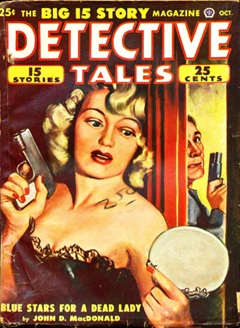
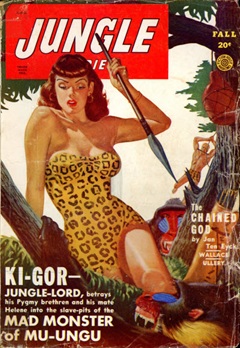
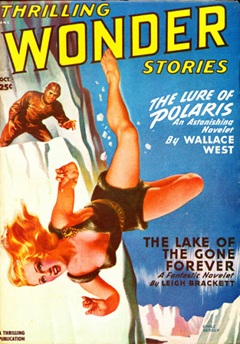
{“The Case of the Man Who Invented Death” aired on a Thursday evening in early October of 1949. The neighborhood gang could hardly wait for school to let out the next day so they could make a bee line for the nearby bookstore to find some of their favorite magazines to devour over the weekend. They were quite eclectic in their choices this visit, selecting from detective, adventure, and SF genres. Detective Tales (1935-53) was the second most popular of Popular Publications line of detective magazines. It ran for an amazing 18 years and published over 200 mostly monthly issues. It was a monthly in 1949. Jungle Stories (1935-54) made its mark as a rowdy sort of takeoff of Tarzan, featuring the adventures of Ki-Gor, Jungle Lord in every issue. As many magazines of the the pulp era were, Jungle Stories was targeted at the young male audience, notably with its covers of beautiful women scantily clad in two-piece leopard skin outfits beckoning young boys to part with their nickels and dimes with every new issue. The cover shown below was one of the few times where the alluring female wore a one-piece outfit. Jungle Stories was a quarterly throughout its run. Thrilling Wonder Stories (1936-55) was one of the triumvirate of now classic SF adventure pulps, the others being Planet Stories and Startling Stories. Each had its own subtle flavor to attract their individual readerships, while all shared the basic selling points of high imagination, a friendly disregard for the restraints of accurate science, and fast-paced, colorful adventure on other worlds. Many of today’s favorite stories are rife with nostalgia among older fans, and have been collected many times in various collections over the years. Many of these most-favored stories were penned by some of the most well know and beloved authors of the genre, including Leigh Brackett, A. E. van Vogt, Murray Leinster, Henry Kuttner, Robert A. Heinlein, Leslie Charteris, Jack Vance, Edmond Hamilton, James Gunn, Isaac Asimov, and more. While TWS flirted with monthly and quarterly schedules briefly, it was far and away a bimonthly publication for almost all of its run and was a bimonthly in 1949.}
[Left: Detective Tales, 10/49 – Center: Jungle Stories, Fall/49 – Right: Thrilling Wonder Stories, 10/49]
To view the entire list of weekly Old Time Radio episodes at Tangent Online, click here.