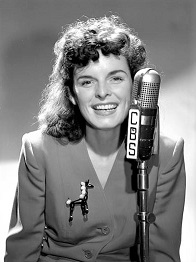
 Defense Attorney (aka The Defense Rests, 1951-52) aired “Peter Lynch” on August 17, 1951 as the 7th of its 75 episodes, of which only 13 are known to still exist. The audition took place in April of 1951 under the working title of The Defense Rests, but when given the green light and its first episode aired in July it was rechristened as Defense Attorney. Broadcast on Friday nights, each episode was devoted to righting a wrong, to defending a person unjustly accused–-or actually convicted and sentenced, sometimes to the electric chair–-for a crime they did not commit. It starred Mercedes McCambridge (1916-2004) as Defense Attorney Martha Ellis “Marty” Bryant.
This is only the 3rd episode of Defense Attorney we have offered, the first being in November of 2017, and the last coming in June of 2021, over 5 years ago, so a reprise of the original introductory notes is in order. McCambridge was fresh off her Oscar win as Best Supporting Actress in 1949’s All the King’s Men (Oscar winner, Best Picture), and in 1956 she would be nominated again in the same category for her role in Giant. Giant starred none other than Elizabeth Taylor, Rock Hudson, and James Dean (with an all star supporting cast including Rod Taylor, Carroll Baker, Dennis Hopper, and Sal Mineo). Of interest to genre fans, McCambridge was the voice of the demon Pazuzu in 1973’s The Exorcist. Orson Welles, one of the most revered names in early radio and later film, touted McCambridge as “the greatest living radio actress.” Mercedes McCambridge has two stars on Hollywood’s Walk of Fame, one for her film work and the other for her television work, which was extensive, including the following genre credits: Lost in Space (1966), Bewitched (1968), and Amazing Stories (1986).
As a side note, McCambridge was pregnant with her second child (the first died during childbirth) during the first 30 episodes of Defense Attorney. She was a vocal advocate for having children, believing that everyone needed to be needed, and none more so than children. She also strongly believed that having babies should not interfere with a woman’s career, holding the opinion that if she could juggle a radio and film career with having babies, then other women could as well.
Defense Attorney differs from the usual private eye/detective radio programs we’ve come to love in that while these stories show the evil doers getting killed or put behind bars for their crimes, Defense Attorney tells the stories of those few who have been wrongly accused, imprisoned, or worse, who are about to be put to death.
This episode is an odd one, even for defense attorney Marty Bryant. She has no client to defend but finds herself saving a man’s life nevertheless. An ex-con, the Peter Lynch of this episode’s title, has done his time in the joint and has been released on parole. Scarcely a day after his release and out for a late walk he is seen talking to a policeman who is later found dead. Of course, Lynch (what an appropriate name) is being blamed. On the run and panicked, knowing he can never spend another day behind the walls–especially for a crime he swears he did not commit–Lynch climbs out on the ledge of an office building window 8 floors up and promises to fall to his death unless he can talk to Marty. The plot gets curiouser and curiouser as Lynch tries to explain his story, even though all the evidence points directly to him as the cop killer. With Marty’s assistance (and some help from the police), new facts are revealed about a most disturbing set of circumstances, not the least of which leads to several murders and a bizarre scheme to frame Lynch, an obvious scapegoat for the real murderers. The who and why of all this makes for an intense half hour of drama as Marty Bryant, defense attorney, saves the life of “Peter Lynch.”
Play Time: 29:37
{This episode of Defense Attorney aired on a Friday night in mid-August of 1951. With the start of the new school year only a couple of weeks away, the neighborhood gang knew this was one of the last times they could hit the nearby newsstand before they’d have to start hitting the books. As such, their interests were more varied than usual this time around. Adventure (1910-1971) began as a response to Argosy, which was selling around 100,000 copies an issue. Where Argosy ran the full gamut of fiction genres, Adventure concentrated on stories loaded with danger and thrills. While obviously successful, it nevertheless refocused its emphasis to an unabashed men’s adventure magazine in mid-1953, and in the early 1960s combined its fiction with non-fiction around finding or seducing women in exotic locales (one such article from 1961 teased with the title “Why I Became a Harem Girl,” while another from 1962 titillated with “They Were Fearsome Animal Women and They Lusted For My Life.”) Scantily clad females on its covers by this time were a staple as well. A monthly for most of its run, in 1951 Adventure transitioned to a bimonthly mid-year, seeing 5 monthly and 3 bimonthly issues for a total of 8. The issue shown below was the first of these bimonthly issues. Ellery Queen’s Mystery Magazine (1941-present) is the longest running mystery magazine of all time, well into its 85th year and close to 1,000 issues, a remarkable accomplishment. It featured classic as well as new material for a number of years in the 1940s and ’50s from many of the legendary mystery and detective writers in the field. It was a monthly in 1951. F.B.I. Detective Stories (1949-1951) caught the tailwind of Federal Agent story interest and lasted but 14 bimonthly issues. The issue shown below was never published, though obviously the cover had been printed for this final issue. In this fictional universe, the issue did exist and one of the neighborhood gang bought it.}
[Left: Adventure, 7/51 – Center: Ellery Queen’s Mystery, 8/51 – Right: FBI Detective, 7/51]


To view the entire list of weekly Old Time Radio episodes at Tangent Online, click here.