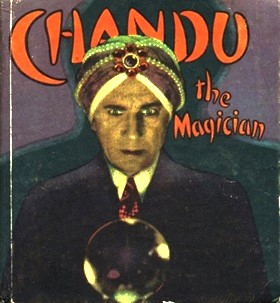
 Chandu the Magician (1932-35, 1948-50) aired “The Voice of Darkness” on April 14, 1949 as the 11th of the 13 half-hour episodes that began in February to begin the 1949 season. It ran until the end of April when the summer hiatus would intervene, the show picking up again in November with its final 6 episodes that would end the year with its Christmas Eve show. The show’s final season (consisting of another 6 episodes) would run from July 26th to August 30th, 1950. This is the 6th episode of Chandu we’ve offered since the first in April of 2023, the last coming in June of 2025, over a year ago.
The first run (1932-35) consisted of daily 15-minute episodes that became popular very quickly, so much so that a 1932 film soon followed the radio adventures of Chandu. The idea behind Chandu the Magician stemmed from the public’s interest at the time with Eastern mysticism and the occult. The Chandu character’s fictional real life name is Frank Chandler. Chandler has spent many years in the Orient studying the mystic arts and is now adept at astral projection, conjuring illusions, and teleportation among other magical abilities he uses when necessary. If this sounds like a familiar set of superpowers it was, witness magazine and radio close contemporaries like the Shadow or Mandrake the Magician—though Chandu on radio was the first. The original story arc sees Chandu chasing after the evil Roxor, who has kidnapped the husband of Chandu’s sister, Dorothy Regent. Chandu and his sister travel to all sorts of exotic locales in search of her husband (who was thought to have disappeared in a shipwreck but later to have disappeared at the hands of Roxor). Roxor, as all truly evil villains are, is bent on conquering the  world and will stop at nothing to accomplish his egomaniacal ends. For the original 1932 movie, actor Edmund Lowe played Chandu, while none other than Bela Lugosi took the role of Roxor. For the 1934 sequel, however, in a surprising role reversal Lugosi was honored with the role of Chandu.
A crucial bit of the history of the show would be incomplete without mentioning that a great part of the radio show’s success was due to a young woman by the name of Vera Oldham, a former office girl who proved good on her aspirations to write. After the radio series ended in 1935 and the Chandu films were long over, Chandu was resurrected on radio in 1948, with the former story arc refurbished and updated (even bringing back Oldham to touch up the scripts), continuing Chandu’s travels to mysterious and little known parts of the world (the fabled land of Lemuria for one), and gifting him with a love interest of surpassing beauty in the character of the Egyptian princess Nadji.

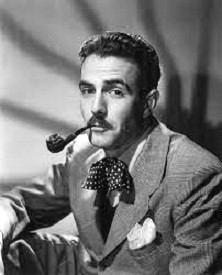
 For the 1948-50 radio revival, the episodes from June of 1948 through the end of January 1949 were daily 15-minute episodes, then from February of 1949 through the final show on September 6, 1950 Chandu would become full half hour, self-contained stories, of which this week’s episode is one. Tom Collins (1913-73, photo top right) would become the new voice of Chandu, Irene Tedrow (1907-1995, photo at right) played his sister Dorothy, and film actress Veola Vonn (1918-1995, photo at left) was Princess Nadji, who is given a prominent role in this episode. Besides her dual careers in radio and film, Tedrow would also make a name for herself in television, appearing in dozens of shows, a very few among them being Dennis the Menace (1959-63, 26 episodes as Mrs. Lucy Elkins), Dragnet, Leave it to Beaver, The Twilight Zone (episode “Walking Distance” from October 30, 1959; ranked as the 9th best TZ episode of all time), Perry Mason, Wagon Train, Bonanza, The Andy Griffith Show, The Fugitive, Hogan’s Heroes, Kung Fu, Magnum P.I., L.A. Law, and a veritable host of others. In 1939 Tedrow married William Kent, a refugee who came to the United States to escape Nazi Germany. He passed away in 1974. Tedrow died on March 10, 1995 in Hollywood from complications arising from a stroke. She was 87.
Of passing interest to science fiction fans is that as a youngster the late, great Ray Bradbury (1920-2012) was captivated by the radio episodes of Chandu the Magician. According to his wiki page, “He listened to the radio show Chandu the Magician, and every night when the show went off the air, he wrote out the entire script from memory.”
“The Voice of Darkness” finds us in Egypt, Cairo to be specific. British Captain Roger Gaylord, recently departed from the army, has come to Egypt to raise cotton of all things. Our story starts with a bang, as Gaylord’s home is blown to smithereens with him inside. Princess Nadji was a friend of Gaylord’s and was on her way to visit her old friend when the “accident” occurred. Unraveling the circumstances around the deadly explosion leads to Nadji being framed as a prime suspect. This gets her other old friend, Chandu, brought into the story. And this is where things get interesting, as a series of mysteries and secrets involving hypnosis, lies, spies, a truly evil villain, and thousands of years-old manuscripts containing powerful spells that would make their owner master of the world, are the moving parts in this trip into the stygian depths of Egyptian antiquity, focusing on the sorcerous entity known as “The Voice of Darkness.”
Play Time: 30:07
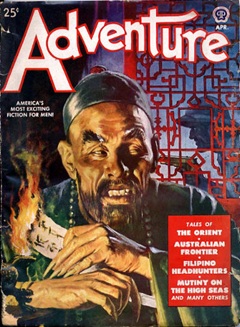
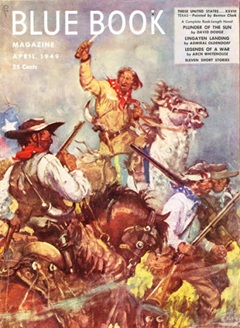
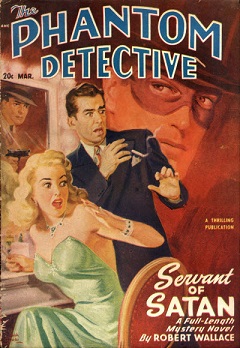
{Broadcast on a Thursday evening in the middle of April 1949, the neighborhood gang was enthralled by yet another adventure of Chandu. After school the next day and with the start of the weekend at hand, they beat feet to the nearby newsstand looking for more adventure wherever they could find it in some of their favorite pulps. Adventure (1910-1971), as we have noted here many times before, was begun in answer to Argosy, which was selling in the hundreds of thousands of copies an issue. While Argosy printed all kinds of fiction, from romance to adventure and everything in between, Adventure offered much the same general format but with its much narrower focus on thrills and danger to attract its perceived audience. It was a monthly in 1949. Blue Book (1905-1956) began primarily as a woman’s magazine, but after several decades branched out slowly to stretch its literary wings to include other kinds of stories of interest to women, and then to both sexes, witness Edgar Rice Burroughs appearing in the magazine from 1916-1932 with no fewer than 11 appearances, including but not limited to Jungle Tales of Tarzan, The People That Time Forgot, Tarzan and the Lost Empire, and A Fighting Man of Mars. Blue Book was a monthly throughout its nearly 50-year run. The Phantom Detective (1933-1953) was created in answer to Street & Smith’s wildly popular pulp hero magazine The Shadow. Though The Phantom Detective’s overall output didn’t match that of The Shadow (175 to 325 issues respectively), it published for more years and thus holds the title of the longest-running single-character pulp of them all. It managed 5 issues in 1949, beginning as a bimonthly and ending as a quarterly.}
[Left: Adventure, 4/49 – Center: Blue Book, 4/49 – Right: The Phantom Detective, 3/49]
To view the entire list of weekly Old Time Radio episodes at Tangent Online, click here.