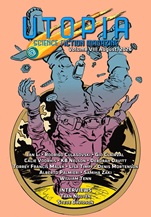
 Utopia Science Fiction Vol. VIII, August 2026
“Lockdown on the Moon” by Denis Mortenson
“Limited Entity” by Gio Clairval
“Sentinel’s Redemption” by Calie Voorhis
“Her Hair the Color of a Sun-Red Orange” by Rodrigo Culagovski
Reviewed by Malory
There were four stories in this the eighth-anniversary issue, and Tristan Evarts uses his editorial to announce that Utopia will be moving to print as well as their digital edition, which is great news!
“Lockdown on the Moon” by Denis Mortenson opens with a man drinking with his lover outside Les Deux Magots in a Paris that keeps going soft at the edges. We quickly deduce that this is because he’s really a convicted murderer in a stasis tube in Lunar Lockdown Section 41 and the version of Paris he’s experiencing is being piped in. Mortenson crafts the city exceptionally well. I can feel the rain and smell the omelets and have a great sense of the flirtatious waiter. Likewise, the sense of creeping wrongness is nicely established in how the same afternoon keeps nearly repeating. I guess, though, my problem with the story, is that we’re told the narrator knows he’s in a simulation before the first page is even out. I think that’s a shame, because it means that everything that comes afterwards (the tube, the technicians, the drug and then the passageway) is merely a confirmation of that, rather than it being a fresh discovery. That’s not a deal breaker, but it does mean that, as a reader, we’re never in a position to be wrong about anything. And, of course, that the break-out sequence has nothing in it to withhold. However, there’s a Casablanca gag late on that made me howl, so it’s got that going for it.
“Limited Entity” by Gio Clairval is, without question, the standout of the four. The Key to a starship drops from its dead Captain’s fingers onto a deck and then gets stolen, bought, worn, pocketed and abandoned across a marketplace all while the ship’s hull breach ticks down. It turns out, though, that the Key needs a Captain. And the impossible criteria for being one were etched four hundred years ago by a species that is now extinct. What I love most here is the committee of Advanced Artificial Entities. They spend the story squabbling and this is genuinely well done. The voices are funny and irrelevant, and yet there’s still a properly well-crafted story beneath all of the humour. My one gripe is that the closing line spells out a judgment that I really do think the reader should’ve been trusted to reach on their own. Still an awesome read, though!
“Sentinel’s Redemption” by Calie Voorhis is set in a realm where organised magic has run out and electricity is an arcane discipline nobody’s much good at. This is a crackling good premise, and Voorhis sells it hard. The MC is a brilliant wizard (and a terrible electrician) working from a salvaged copy of the Scientific Basis of Electrical Engineering. All the little details are excellent and the dead friend whose eyes melted and is still screaming is powerfully done. Oh, and the guy sitting three feet off the ground in a lotus position and arguing with her about whether she gets to join him, is the best scene across the whole issue. Which is why the conclusion frustrated the life out of me! After four pages of very specific hardware we are left with reality twisting and contorting and “a sensation beyond pain, beyond comprehension.” For me, I found this sudden lack of clarity as to what was going on to break the immersion all of the hardware details had built. Nevertheless, this was still very good, and I’d certainly be keen to read more tales set in this world.
“Her Hair the Color of a Sun-Red Orange” by Rodrigo Culagovski opens with a seven-year-old chasing an orange around her mother’s fruit stall in the All Sentients Plaza. This is a market where the customers are Maxolinians, tentacled Grrmons, stony Zy-Luhs and CyThrees who can’t eat fruit but queue up for it anyway. I enjoyed the way Culagovski builds his station out of throwaway clauses, which avoids any sense of infodump and what’s really well done here is that there’s nobody in the story who’s entirely a ‘good guy’. However, where it all gets a touch thin on the ground is that too much of the tale is delivered after very long conversations. Also the figure of Camelia carries rather more expositional weight than a character should have to. The bigger sin, though, is that the turning point of the whole story lands in the white space of a section break… which is a shame.
Overall, it’s a bit annoying that three of these four ‘very good indeed’ stories end with a lack of clarity, or have their big moments happen in the background, or give up a major first-page disclosure. Thus, it’s the one that doesn’t that I’m recommending.