 Sci Phi Journal, Autumn 2026/3
“The Last Witnesses” by Christian Emecheta
“Our Home Is Safe” by Mark Ifanson
“Panic On Petrov” by Gorden Linzner
“New And Improved” by Thomas Canfield
“Homogenia” by Georghe Sâsârman, (translated by Monica Cure)
“Transport Manifest” by Diana Parrilla
“On Birthdays, Turnagún” by Arturo Sierra
“The Ministry Of Continuity” by Carol Mbugua
“On The Arguments For A Transcendent Programmer Of The Universe” by John McLaughlin
“In Divisible” by George Salis
Reviewed by Borealice Winters
Every issue of a given magazine is an individual species of the same genus, driven by the same base instincts but with different phenotypes. Seeing as this is the second time I’ve reviewed an issue of Sci Phi Journal, it is inevitable that I will be coming at this review with preexisting expectations. I will therefore make comparisons, when apt, with stories from the Summer 2026 issue. For those unfamiliar with the publication, I’ll crib what I said about it in my last review: it is more Borges than Battlestar. (Fittingly enough, one of the essays in this issue is about Borges, and though I am not including a review of said essay here, it is well worth reading.) If this is your first plunge into the magazine, I’d suggest this approach: if you come expecting plot and character to be vehicles for speculative philosophy, theology, sociology, and/or worldbuilding, you’ll be rewarded.
On the surface, “The Last Witnesses” by Christian Emecheta displays many of the qualities I’ve come to expect from a Sci Phi Journal piece. The setting, a version of Earth sometime after the year 2047 in which urban planning by sentient nanotechnology has created unintended gateways to other dimensions, feels mainly like an excuse to explore speculative biology, the consequences of industrialization, and transhumanism. The plot, wherein pan-dimensional alien parasites attack Earth and cyborg soldiers have their consciousnesses transferred to drone swarms to fight back, is told in an experimental way: as a transcript of an in-universe interview with a once-human man who has become one of those drone-swarm soldiers. The interview format leads to direct and distant prose, which means that the success of the work hinges not on the strength of said prose, or its characters, or its narrative, but on the strength of its ideas. All these qualities (experiments with form, worldbuilding as a catalyst for philosophical discussion, said philosophical discussion being the focus, etc.) are characteristic of the publication.
All the above having been said, I cannot help but compare it a little unfavorably to a piece from the summer issue, “The Number That Shapes The Universe” by Giulia Cassarà. Both take the form of transcripts of in-universe media; both are set in the aftermath of each respective story’s principal incident and analyze said incident’s implications; and both make an effort to ground higher philosophical stakes in the smaller stakes of individuals. That said, Cassarà’s “The Number That Shapes The Universe” from the summer issue, for me, achieves all three of these goals with more verve than this autumn’s “The Last Witnesses.” Therefore, if the latter piece sounds interesting to you based on my description of it, or if you read “The Last Witnesses” and enjoy it, I would highly recommend rummaging for the summer edition of Sci Phi Journal and giving “The Number That Shapes The Universe” a peek. That said, “The Last Witnesses” is a strong opening to the issue in displaying many of the hallmarks that make Sci Phi Journal what it is.
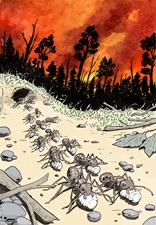
Returning to the present issue brings us to a miniature: “Our Home Is Safe” by Mark Ifanson. It takes the form of a series of fragments tagged with a day of the week, starting on Thursday and ending the following Wednesday, and depicts human invasion of an unnamed world from the perspective of an indigenous, tree-dwelling species about whom we learn little detail. This paucity of detail (all we really know is that this species lives in something its members call a “tree,” that they leave pheromone trails, that they have an egg-laying Queen, and that they are no match for humans) gives the piece a strong allegorical bent: it is far more about the human campaign against Earth’s natural world than it is about manifest destiny among the stars. The structure, being a march of days, gives a similar feeling, as it makes the piece feel like a myth of anti-creation (for as the Abrahamic God made the world in a week, so too does it take a week for the tree-dwellers to meet their inevitable fate). It is a brief and laudably clear piece, but the clarity of its intent and approach is so stark that I come away from it hungry for a little nuance, subtlety, or for a little extra wrinkle. That this is the piece’s biggest sin should be taken as evidence of how well the author executed upon his intent.
I opened this review by saying that every issue of a given magazine is an individual species of the same genus, driven by the same base instincts but with different manifested characteristics; therefore, it is fitting in a way that Gordon Linzner’s “Panic on Petrov” feels metafictionally unique from the other pieces in this issue, and that its subject matter concerns a planet whose every biological inhabitant seems distinct from every other, where the concept species doesn’t seem to exist. This latter fact is noted by one Lieutenant Janet Santiago, a researcher who lands (rather gracelessly) on the titular Petrov. Her goal is to assess the planet as a viable candidate for colonization, and doing so entails ensuring none of the over 41,000 unique entities on said planet display human-like intelligence. While I won’t spoil the conclusion, it feels less philosophical (or, depending on your perspective, less navel-gazing) on the whole than most (if not all) of the pieces in either the autumn or summer issues of Sci Phi Journal. Its tone is irreverent, and while that’s not intrinsically unusual (in the summer issue, for example, both “The Summoning of Stellar Gods” by Lily Lachance and “Earth Has Mail” by Richard Lau have strong whimsy), said tone here almost undercuts an already simple message. The degree to which a given reader enjoys this piece depends, in my mind, on two factors: first, is the tone a delightful shift from the more serious approaches of the last two pieces, or is it grating? Second, does the fact that its approach feels more driven by character and comedy than philosophy add flavor to the issue, or does it feel like a departure from the stated intentions of Sci Phi Journal’s editors? I personally find “Panic on Petrov” to be a fun romp, but I nevertheless wish there was a little more speculative or philosophical meat on its bones.
“New And Improved” by Thomas Canfield details the production and testing of a ‘new and improved’ dog, one genetically engineered to be friendly and docile regardless of how it’s treated. This dog is named ‘PM’ (Production Model) by one of the piece’s two main characters: Lauderdale, the researcher in charge of the project. Much of the narrative revolves around Lauderdale discussing details of the project with his wealthy boss Westervelte, a man who does not respect him. While “New And Improved” explores themes of cruelty and mankind’s tendency to force the world into a shape of his choosing, the core of the piece is a thematic connection between the dog and Lauderdale. It is a connection that, for me, does not quite land. There’s a certain distance and lack of detail that robs the piece of some of its power. As one example, we learn that PM is the eighth production model, but, while we’re told that earlier models were failures, we never see why, don’t dwell on the fact that they were likely post hoc discarded, and never feel attached to their plight. A stronger sense of detail surrounding this and similar plot points may have obviated the need for Westervelte to outright state the thesis of the story in what feels like slightly clunky dialogue. All that said, the thesis is rather interesting, and the way it is presented feels fresh even if its execution feels a little like a missed opportunity.
Unless I have erred, only two people appear in both this issue and the summer issue, which I reviewed previously: Georghe Sâsârman, author, and Monica Cure, who seems to be his go-to English translator. In this issue, we see Sâsârman’s “Homogenia.” I discussed, as best I could, the nuance of reviewing a translated work in my review of the summer issue, and I won’t repeat said discussion here. I will say, however, that whether it’s a credit to the original work or to the translation, “Homogenia” feels much stronger to me than Sâsârman and Cure’s summer issue piece “Protopolis.” “Homogenia” is an almost Borgesian or Stanisław Lem-like thought experiment that, like some of Borges’s or Lem’s works, eschews narrative almost entirely and become a direct exposition of an idea. In this case, the idea is as follows: what if there was a city that was almost fractally self-similar, with one house on one street in one neighborhood replicated to make up the entirety of said city? What if said city influenced its population to become equally homogenous, until all differentiating factors between individuals were abstracted away? “Homogenia” depicts such a city and presents a plausible account of how such a city might have that flattening effect on society. The tone is very distant, almost academic, in a way that thematically benefits the piece, and the end contains an example of a fun, though far from new, structural feature in fiction. My only critique is that feels like the last crucial piece of thematic scaffolding or satirical bite, the sort you’d find in the best of Borges or Lem, feels absent. This feeling is not helped by the fact that Sâsârman’s “procreation came to be considered a grave misdeed” is reminiscent, to me, of “mirrors and copulation are abominable, since they both multiply the numbers of men” from Borges’s “Tlön, Uqbar, Orbis Tertius,” and that this, along with the aforementioned similarity in tone between the work of Sâsârman and the work of Borges, almost invites comparison. Despite that, “Homogenia” is, to me, one of the best pieces in the issue.
It’s understandably difficult, then, for whichever piece follows “Homogenia” to stand out. “Transport Manifest” by Diana Parrilla does so with its striking experiments with form. It is an epistolary piece presented, unsurprisingly, in the form of a transport manifest. Through a series of timestamped snippets, we follow the first-person logs of L. Jensen as they transport the consciousness of Dr. David Kaman, a scientist who invented a protocol for consciousness transfer, to a facility where that very process will be performed on Kaman himself so that his research may continue. A brief chase by a somewhat generically named and defined “liberation front” ensues, which leads Jensen to a choice: continue the mission and give Kaman to a government who will use his research for ill, give Kaman to the liberation front who may be better than the (by implication) tyrannical government in name only, or destroy Kaman? While my synopsis may make the choice feel obvious, there is a surprising and refreshing note to the ending. All that said, the approach to the writing feels like it strains against the form in a way that feels muddy rather than intentionally paradoxical (what transport manifest has phrases like “the cube gleams like captured moonlight in my transport pod’s cargo bay” or “humanity’s future rides in frozen silence behind my pilot’s chair?”). In addition, its scattered references to Dante, Greek beliefs about eternity and the mortal body, Camus’s Sisyphus, Einstein’s view of time, and quantum physics are conceptually interesting, but the sheer number and variety of these references feel diffuse and shallow in such a short piece. I would love to see a version of this story with a deeper and more narratively interwoven exploration of one or two of the aforementioned concepts. What we have, though, is nevertheless an ambitious piece that’s well worth the read.
I mentioned that Sâsârman’s “Homogenia” is reminiscent of Borges and Lem. I will now qualify that if “Homogenia” owes more to Borges than to Lem, then Arturo Sierra’s “On Birthdays, Turnagún” owes far more to Lem (particularly to the dry whimsy of Lem’s Star Diaries or The Cyberiad). Much like Sâsârman’s piece, “On Birthdays, Turnagún” is an almost academic description of a world different than our own, but here, the dry prose is put into comic relief against a convoluted planet (or, “moon-moon”) called Turnagún. Through the opening lens of birthday traditions, we learn that the titular Turnagún is a moon orbiting another moon that’s orbiting a larger planet; we learn how these complicated orbital dynamics affect perceptions of the passage of time and elevate the science of astrology to a chief and serious cultural institution; and we learn, ultimately, how all of this spoils attempts by the wider galactic community commune with Turnagún’s people. No synopsis can do the experience of reading the piece justice, and I fear I may have already given too much away. Given its fresh ideas and strong presentation, I recommend “On Birthdays, Turnagún” more than any other story in the issue.
We now move from a whimsical, almost rambling piece to something tight, fragmented, and quite serious. “The Ministry Of Continuity” by Carol Mbugua presents an alternate world (presumably a version of Earth, though it’s never stated) wherein the ‘death’ and subsequent consciousness of government minister Halvorsen leads to there being two Halvorsens: one being the original, and one being the backup consciousness implanted into an identical body. We see in fragments as this escalates, with more than a touch of surrealism, until there are countless Halvorsens, until there are seemingly copies of other citizens (although this particular angle is almost woefully underdeveloped), and until the very concept of personal identity is called into question. The blend of harder speculative fiction with something more surreal is quite interesting and mostly comes off well.
My biggest critique is this: there are a number of pithy statements whose sequence of words sounds reasonable and even, perhaps, profound, but which are vague enough to crumble a bit under scrutiny. E.g. “It felt like losing a word I didn’t know I was speaking.” How does one feel the loss of something they’re unaware of? Does ‘lose’ in this context mean ‘forget,’ or is it something more metaphorical? If the latter, what is the underpinning of said metaphor? I have no objection in principle to more oblique or poetic descriptions (see my review of the last story in this issue), but there were enough similar lines in this story, lines that caused me to step back and ask ‘what is this actually saying beyond the vague impression it gives’ that I feel my overall enjoyment suffered a little. Still, judged by the core concept, which the editors of Sci Phi Journal tend to value highly, “The Ministry Of Continuity” is compelling.
One isn’t supposed to judge a book by its cover, but “On The Arguments For A Transcendent Programmer Of The Universe” by John McLaughlin has one of those titles that, to me, is almost like a dare. It’s a title that knows it’s bold and promises that the tagged story is equally so. On the surface “On The Arguments For A Transcendent Programmer Of The Universe” is exactly what it promises to be: a series of philosophical arguments, put forward by computers, arguing in favor of the existence of a “transcendent programmer,” or an original creator of all computers. Whether it’s as good or as bold as the title suggests is something only the individual reader can determine.
The philosophical arguments adumbrated in “On The Arguments For A Transcendent Programmer Of The Universe” are versions of real-world philosophies arguing the existence of god (“the first machine cycle” corresponding to the idea of the unmoved mover, and “Epsilon’s Wager” being an almost word-for-word reproduction of Pascal’s Wager, for example). That this is where the story starts and ends, that it never elevates these arguments or escalates beyond them, is both the strongest and weakest thing about it: it’s the strongest because this piece knows exactly what it wants to be and economically achieves that end; it’s the weakest because presenting all these old philosophical arguments (with electronics terms substituted for philosophical or human terms where relevant) means it feels like the story has little new to say. In short, there was a missed opportunity to do more, to transcend beyond the words of past thinkers. What we’re left with is a piece that’s nevertheless quite entertaining to read.
To paraphrase how I opened this review, every given issue of a given magazine is a different beast; Sci Phi Journal’s present autumn issue is not the same as the summer issue was. That said, just as the summer issue ended with something akin to a prose poem in R. Foster’s “A Roll Of The Quantum Dice,” this issue ends with a similarly poetic piece with “In Divisible” by George Salis. There is a strong speculative concept here, one which explores hypothetical subatomic lifeforms attached to the atoms fissioned inside Little Boy and, through them, puts into relief the utter pointlessness of human cruelty in the face of a universe that’s so much deeper and vaster than mankind. Yet it’s the amount of poetic wordplay (starting, of course, with the title itself), the ample rhyming, alliteration, assonance, semantic paradoxes (e.g. surfaced surfacelessness) and other poetic and rhetorical devices that take center stage. I suggested, near the start, that first-time readers should expect the stories to be vehicles that facilitate philosophy and speculative concepts; here, Salis achieves the opposite effect, where science facilitates poetry.
I maintain that Sci Phi Journal is more Borges than Battlestar, but I am almost tempted to add a third ‘B’ to the mix: it’s more Borges than Battlestar, but every so often, perhaps, there’s a touch of Bill Shakespeare, too.