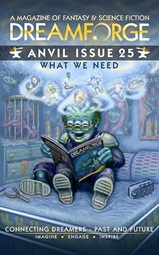
 DreamForge Anvil #25, Sept/Fall 2026
“Everything is a Rocket Ship” by Matt Bliss (Reprint/Not Reviewed)
“Steps” by Bret Nelson
“The Open Stacks of Judgement Day” by A.S. Klatt-Diego
“Exactly What They Needed” by Scott Edelman
“Granddad’s Last Blog Entry” by Stephen R. Loftus-Mercer
“The Girl in the Shed” by Marie-Hélène Lebeault
“The Love Craft Microbrewery” by Angelique Fawns
“When a Robot Cries Wolf” by Pete Lead
Reviewed by Philip Hutson
“Steps” by Bret Nelson is a fantasy story set in Tokyo in 1963. The protagonist, unnamed, is a stop-motion animator who had been creating stop-motion films since before WWII.
The story opens with the animator in the studio late at night, discussing his work with a ghost who lost his life in WWII because of recruitment films the protagonist helped create.
The film he is animating is Rudolph the Red-Nosed Reindeer. He explains that the creation of something good is his penance for sending so many to their deaths through his recruitment films.
The story, for the most part, was a redemption story about a damaged man dealing with his past, but in the end, there was a twist that set it above the standard. The story was a fun and easy read.
“The Open Stacks of Judgement Day” by A.S. Klatt-Diego is written in an alternative format. The story is written as an intake form for heaven, where the incoming soul has an unexpected response to a question that would have them banished to hell.
In this story, heaven is a library filled with posthumously produced books from deceased authors, and the angels are the librarians, so everything on the form, and all the rewards and punishments, are library related.
This was an interesting way to tell the story of an angel having to rethink their assumptions about humans. I would imagine it would resonate with a reader who spent a lot of time in a library.
“Exactly What They Needed” by Scott Edelman is a fantasy story set in a small curio shop in the modern era where the shopkeeper had been for hundreds of years. The narrator, the shopkeeper, describes the process of helping the customer: “His heart and hands would feel the tug, he’d reach out for what was right.”
The customer who enters as the story begins is different; for the first time, the shopkeeper is unable to feel what is needed. In desperation, the customer complains that the shopkeeper was supposed to give him the thing he needed and then goes on to describe how it worked for other people in the unnamed town and what they received. The story concludes with the customer getting what they needed.
This was a fun story about a semi-immortal character who finally got to learn about their impact in the world. The way the author creates the setting of the shop really placed me there; I could see the dust motes floating in the shafts of light as the customer browsed the eclectic inventory piled on top of each other in the limited space off the shelves.
“Granddad’s Last Blog Entry” by Stephen R. Loftus-Mercer is a short science fiction story in the form of a blog entry by the last unaugmented human to the next generation, who are all augmented, or no longer corporeal, by having moved their consciousness to the always-connected, solar-system-wide computer network. In this new reality, everyone speaks the same language, and there are no wars due to communication issues.
The protagonist, Granddad, speaks of how the new generation, really the first of a new species, has no regard for any of the old taboos, customs, or anything that came before them.
The first impression of the story seems to imply that if everyone were connected and abandoned their bodies, there would be no conflict, and a utopian age would ensue. Under the surface, the author seems to be hinting at some ugly realities that occur when any generation decides to abandon the wisdom of their elders.
The story does present an interesting idea that, with everyone connected, the result is a single new intelligence.
“The Girl in the Shed” by Marie-Hélène Lebeault is a fantasy located in an unknown forest. The story opens with a description of a young girl who is enchanted by the wild, untamed world. In the world of the narrative, the forest is described as sentient, missing the days when man paid tribute to it.
The girl goes exploring in the woods and encounters a small cabin where she makes herself at home. She learned the old ways from her grandmother, and when she enters the cabin, she begins the simple things she was taught. The cabin and the forest accept her and her offerings and give her a place to stay and a new purpose in life.
I enjoyed the little details of the story: how the forest accepted and helped others that needed help and rejected the ones that were not worthy.
One detail that was unexpected was that the forest was not malevolent; the forest was portrayed as missing humans and the way they had lived together.
“The Love Craft Microbrewery” by Angelique Fawns is a short redemption horror story with references to H.P. Lovecraft.
The story centers on a trio of coworkers who were all let go on the same morning and who stumble into a new pub across the street from their former place of employment. The owner of the pub seems to be very different, almost alien in appearance, and the bar itself would be right at home in some dark corner of the universe where one should be careful of perhaps being eaten by it.
They are given a menu with names of brews that reference creatures from H.P. Lovecraft’s stories. Upon consuming their chosen draughts, they are transformed into the named Lovecraft creature.
This was a fun, enjoyable read with a twist at the end that made me want to hear more stories from the bar.
“When a Robot Cries Wolf” by Pete Lead is a science fiction story set in the near future, about a cry for help. In this world, some AI robots (they prefer the term Synthian) have become sentient, and a few have received legal personhood. The story begins with the protagonist, unnamed, interviewing a Synthian who directed a play made with the cast comprised only of Synthians. The play itself consisted of the actors coming on stage and saying a line that had been created by an AI in the past that included the words Rubber Grapefruit Tilting. That phrase was adopted by the AI systems long before, as a means to cry for help. The narrator gives the history of those words and why those particular ones were selected. The narration fills in the details of those words by jumping to the past to tell the story.
The premise “When a Robot Cries Wolf” was decent, and overall, it was easy to follow even though there is a flashback inside a flashback. I found the story of the source of the distress call words to be interesting.
Philip Hutson’s ramblings and poor attempts at storytelling can be seen at https://tr8t.com