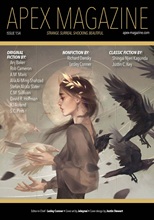
 Apex
Apex “Cervidae, New and Sharp” by Anj Baker
“When I Hear Calypso” by Rob Cameron
“Dispatch From My Ex-lover’s Lower Intestine” by A.M. Maris
“Parts and Halves” by Alia Ai-Ming Shahzad
“It Starts With Teeth” by Stefan Alcala Slater
“The Light Below” by C.M. Sullivan
“Boys of the Fellwood” by David R. Hoffman
“In the Blue Hour” by RJ Aurand
“We Were Once Twelve” by S. C. Pires
Reviewed by Henry Gasko
Before beginning, it is worth keeping in mind Apex magazine’s tagline: “Strange, Surreal, Shocking, Beautiful.” After reading this issue, you might ponder about the accuracy of those words. Yes, the stories are strange; the editor openly confesses a love of the “weird,” which by now is a fully fledged sub-genre of speculative fiction, easily distinguishable from plain old fantasy and even somewhat removed from “normal” magical realism.
And by virtue of being weird, they easily qualify as “surreal”: stories that are deliberately trying to access what many claim are “deeper truths” that only the subconscious can grasp. So be warned: you are going to be served a steady diet of stories that can only be understood (if at all) as myths, fables, and allegories. Modern fiction has come a long way since Matthew Arnold said, “Have something to say, and say it as clearly as you can.” If that is the type of story you are after then, as Dante said, “Abandon hope all ye who enter here.”
And on the surface, the stories are indeed “shocking” in the everyday sense of the word. In fact almost every story here comes with one or more content warnings, with body disfigurement being almost mandatory. But it soon becomes apparent that these are calculated “shocks” with little that is truly visceral; these shocks spring not from the stuff of nightmares but from carefully calibrated “edginess,” stories that are often self-consciously strident in their attempts to outdo each other.
As for the final claim of “beautiful,” we all know where that particular attribute resides. Certainly there is nothing here that could be described as conventionally beautiful, with genteel and graceful prose. But the word “beauty” can also be elicited by a well-crafted story, and that must be determined for each story on its own merits. So on to the stories.
The first is “Cervidae, New and Sharp” by Anj Baker, and it involves, among other things, a person named Samantha who may be a woman (although her doctors are not sure), and who may be dying of Creutzfeldt-Jakob Disease (CJD) as a result of ingesting prions, possibly because she ate deer meat or perhaps because at some point she was a deer.
As you read the story, you are immediately confronted with the fact that here, as in many of the other stories in this issue, your enjoyment will be determined by how much effort you are willing to invest in deciphering the author’s true meaning, a meaning that you assume lies somewhere buried beneath the multiple allegorical elements. But at a mere 1700 words, with so many disparate and seemingly random components vying for attention, it’s simply not possible to assign any definite meaning to this story, since almost any interpretation is feasible.
This is followed by “When I Heard Calypso” by Rob Cameron, a story of two distinct halves, told in the now over-familiar second person point of view. The first part is set in Chicago and is about a person (only referred to as “you”) who is suffering from some unidentified disease which is causing albinism and growths on his bones. The mother decides that the cure for this is to return him to her homeland of Belize, which she herself has not seen since childhood. There, mother and son are soon swallowed up by the culture of the tropical country, with its heavy emphasis on voodoo mythology, set against the pervasive sound of calypso, and the disease is almost instantly banished.
But the story takes a seemingly random turn when the man wanders into a carnival that leads him to a circus featuring a Jaguar Man held in a cage. But tonight for the first time the man-beast recognizes his true strength and breaks free of his chains to kill the ringmaster who had sought to tame his primal strength, treating it as nothing more than a spectacle for the crowd. So here perhaps the allegory is a little clearer, dealing with colonialism and its overthrow as soon as the protagonist was taken back to his ancestral roots. And the writing is refreshingly bold and direct, something that is not always the case in this type of story.
“Dispatch From My Ex-Girlfriend’s Lower Intestine” by A.M. Maris is probably the clearest of the allegories in this issue. Told in first person, it begins with the narrator describing in convincing detail their decision to embrace anorexia, “the art of deprivation,” and the description makes it clear that this is indeed a conscious embrace, a perspective that might be truer than the usual depiction of a sufferer struggling against the condition.
The narrator, in the course of her wanderings to finally locate some food in the middle of the night, comes across the love interest of the story, a person addressed only as “you.” So a slight twist on the full second person point of view story, with a mixture of first and second, although again it is difficult to see what is gained by this.
They embark on a long courtship which consists mainly of explicit and often revolting images of food, whether in the act of getting it or avoiding it, and whether a partner should be considered as fair game in pursuit of it. Without spoiling the ending too much, it soon becomes obvious that the story is intent on examining all aspects of food dysphoria. And the fact that the images are in many cases gruesome might at first appear to be mocking the issue, but it soon becomes clear that those very images are in fact highlighting the seriousness of the condition.
“Parts and Halves” by Alia Ai-Ming Shahzad is about a family living literally in the hallway of a large office building on the fringes of some future capitalistic society, in a manner somewhat reminiscent of the stairway dwellers of Soylent Green. In this story, a daughter and her mother and grandmother are “part-swappers.” But rather than swapping body parts, they more usually harvest body parts, including their own, for the enhancement of those who can afford better versions, a clear indictment of the “capitalism at all costs” economic system. The extreme hustling eventually leads to a split along generational lines, with lessons learned for all involved. However, the story is the least effective of the ones in this issue, lacking the internal consistency that is necessary even in an allegory.
“It Starts with Teeth” by Stefan Alcalá Slater is perhaps the saddest of the stories here, an allegory this time for what appears to be a type of autism that renders the inner life of the main character empty or at least opaque to the external world. He is part of the NASA space program but is continually by-passed for missions because his managers are extremely uncomfortable with what they perceive as an emptiness to his personality that makes them unwilling to present him to the public despite his superior abilities. That is, until volunteers are needed for a mission to the ice moon Europa and his “icy” personality is now just what is required. After his selection, NASA begins to subject him to a series of physical alterations that will enable him to survive under the moon’s ice, beginning with the teeth of the title.
This summary makes the story sound quite silly, which it is not. It does in fact depict the “outside of place and time” feeling that certain people I know tell me they often experience when interacting with others. However it suffers greatly from confusion since the author has decided to tell the story in a completely jumbled and non-linear style. I know that is very much in vogue these days but here the story is almost over before the reader can make sense of it and appreciate what the author is saying. And that is a pity, since what is being said, even if allegorically, is well worth listening to. And above all else, the descriptions are both accurate and visceral, bordering on that certain type of beauty that was mentioned in the opening paragraphs of this review.
“The Light Below” by C. M. Sullivan is a minor addition to what is now a classic science fiction trope: the civilization that has been driven underground by some apocalypse and is now struggling to find its way back out of the dark. This has been done recently in the Wool trilogy by Hugh Howey and The City of Ember by Joanne DuPrau, both bestsellers, but it goes as far back as George Lucas’ first film THX 1138. And as in each of those stories, the main character here is a rebel disobeying the rulers to eventually climb from the depths to re-discover the once-again green and wholesome world above the ground. And also as usual for this type of story, there is no mention of what kind of apocalypse the humans are hiding from or why the above ground world has been healed but no one has bothered to look until now. So an allegory for humanity’s fear of lifting our heads to look beyond our mundane day-to-day boundaries, one supposes. But it really does not add anything to the sub-genre beyond that clichéd message. And to add to the mundane and dated quality of the story, it is the third one in this issue that is written in second person POV. So much for new and edgy fiction.
“The Boys of the Fellwood” by David R. Hoffman is the first of the flash pieces. The story features a group of males who, when they approach puberty, literally begin to sprout armor on varies parts of their body. But our main character finds that the armor itches incessantly and makes it impossible for him to embrace his lover, until he finally rips it off so that he can get closer to her. But that is only after the armor has served its purpose and shielded him in his coming-of-age trial against a ghoul. So a clever metaphor (it’s really too short to be called an allegory) for rampant hyper-masculinity that acknowledges, if only tacitly, that armor sometimes does have its uses.
The last new story in the issue is “In the Blue Hour” by RJ Aurand, a very short ghost story about a deceased woman who simply won’t take “No” for an answer. There are hints here of something more profound than simply a woman who was unpopular in life, hints that are at least partially confirmed when our main character discovers the perhaps too-simple solution to what the ghost-woman actually wanted all along.
The final piece is “We Were Once Twelve” by S.C. Pires, about a family where the children regularly go missing, while a mysterious “Uncle” lurks unseen in the shadows, disrupting their otherwise idyllic life on a farm. Is it an allegory for child abuse in a rural setting, or is that looking for a deeper meaning where the author’s sole intention was merely to invoke a squeamish fascination as the children realize the fate that awaits them? Like all good horror, some context and motivation would have gone a long way to making the story truly memorable.
That completes the discussion of the new stories in this issue and it remains only to come to a conclusion about the tagline beneath the magazine’s masthead. And while many of the stories are trying a little too hard to be “strange, surreal, shocking,” and while many of them prefer to indulge in obscure allegory, believing that to be the only means of telling their particular truths, at least one or two do have some claim to a certain type of beauty.