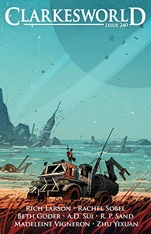
 Clarkesworld #240, September 2026
“Water-Eaters” by Beth Goder
“When Humans Are No Longer Born Human” by Zhu Yixuan
“To Walk This Distant Shore with You” by A.D. Sui
“And So I Open My Fists” by Rachel Sobel
“Fistful of Antimatter” by Rich Larson
“Country Music” by Madeleine Vigneron
“Skin and Glass by R. P. Sand
Reviewed by Borealice Winters
This is not my first time reading Clarkesworld, but it is my first time reviewing it. There’s almost something intimidating about diving in and giving my unwarranted opinions on a magazine that warrants the praise it gets; as such, it feels almost auspicious for my first dive that the first piece so heavily involves water.
“Water-Eaters” by Beth Goder involves an interspecies negotiation between two parties: there’s the human Tabitha, who represents the interests of a group of interstellar travelers in dire straits who need a planet upon which to settle; and then there’s Ulan-12, representing the titular “water-eaters,” a species of water blob creatures filled with floral membranes. The story wastes no time in establishing a clear and compelling conflict. Tabitha wants to establish settlement rights for her people, and all Ulan-12 wants in return is to eat her arm. We see in the actions and interrelations of the water-eaters that such a request is both culturally significant and biologically trivial to them in a way it is not for Tabitha. In many ways, the way this tale explores how alien culture influences humans who interact with it recalls elements of Ted Chiang’s “The Story of Your Life,” but the way Goder handles it feels fresh.
That said, there are some elements I feel are undercooked. Most notable among these is the group of human travelers whose plight drives Tabitha’s negotiation. They exist mainly to drive the plot and Tabitha’s character motivation, but they are otherwise nebulous in some respects. Tabitha has no relationship with them, it seems, aside from her obligation to do what she feels is best for them. This makes her choice at the end, which I won’t spoil, ring perhaps a bit hollower than it otherwise might. This is unfortunate when perhaps my favorite part of the story comes while Tabitha is thinking about her people and their starship, when her internal monologue has this to say: “Closed systems are always dangerous.” This statement seems to indicate not only the closed system of a starship, but perhaps the closed system of insular, anthropocentric cultural thinking. If exploring this idea was the intent, “Water-Eaters” is a success overall even if aspects of it left me wanting.
The editors of Clarkeworld were either quite clever or quite lucky in their organization of this issue. For in the immediate aftermath of “Water-Eaters,” a story in which a human struggles to commune with water, Zhu Yixuan opens “When Humans Are No Longer Born” with the sentence “The first time I saw her, she was trying to prove to a water dispenser that she was human.” What follows from this sentence forms a nice thematic juxtaposition with the previous story: whereas “Water-Eaters” is about a human contemplating humanity in the face of extraterrestrial contact, “When Humans Are No Longer Born” is about ostensible non-humans (clones, cyborgs, and computers, basically) grappling with identity in the face of societal forces which hold prejudice against them for their inhumanity. This angst centers around human identity certification. The unnamed first-person protagonist, a “pure-blood human” born from stored sperm and egg cells and raised by cold caregivers and algorithms, proctors the human identity certification process for Lan, a natural human child adopted and raised by clones. Lan is driven to pass human identity certification as quickly as possible because she wants the right to vote; the Born Human Act, which grants newborns the privilege of being presumed human at birth without the need for identification, is of great importance to the pregnant Lan. This leads to a level of thematic tension between the protagonist, born biologically human but raised in a cold and almost mechanical fashion, and Lan, whose childhood under a pair of legally less-than-human clones hews closer to what readers would recognize as a traditional upbringing.
The speculative concepts Yixuan plays with are fascinating. One example: only biological, natural humans are allowed to vote because of an incident wherein corporations produced clones to rig an electoral demographic shift. Similar incidents justify, in-universe, the barring of AI and other entities determined “non-human” from voting in a way that feels plausible.
If there’s one aspect of this story I might peg as weaker than the rest, it’s the protagonist. The unnamed protagonist admits that they “don’t understand what a human really is,” which is interesting; but they also believe some of the individuals whose human identity they reject are “more human than they are,” which feels at odds with the aforementioned lack of understanding. In short, the protagonist at times feels self-aware about tension inherent in their character, that is, the way they’re biologically human but socially and emotionally mechanical, in a way that feels more like a convenience for the reader than a compelling character trait. As a result, the end falls a little flatter than it otherwise might have. All that said, this is still a piece worth reading and a worthy addition to this issue of Clarkesworld.
“To Walk This Distant Shore with You” by A.D. Sui explores themes of human identity from a different angle than the last two: if “Water-Eaters” questions how to remain human (or if one even should) when introduced to extraterrestrial culture, and if “When Humans Are No Longer Born” explores how fuzzy and arbitrary the qualifier “human” becomes once clones, cyborgs, and AI are sufficiently advanced, then “To Walk This Distant Shore with You” is a treatise on, among other things, the way time and memory change identity. Here, the first-person protagonist reflects on their relationship with a second-person character. “You,” in this case, are intelligent, capable, and are ultimately slated to become a colonist to a distant world the protagonist ends up calling “Three.” Said protagonist, in contrast, is average in every way that society values, and is instead picked to remotely jack their mind into an almost crab-like construction drone to construct that distant colony. What follow are ostensibly reflections on how this transhumanistic remote piloting process alters the protagonist’s sense of self in a fundamental way; I’ve already indicated above, though, how I feel this piece actually reflects on nostalgia and lost time, presented through the lens of a remembered friendship with, and a perceived inferiority to, “you.”
This marriage of the conceptual and the emotional is, for the most part, effective, and the premise is a strong shelf upon which Sui hangs a number of compelling philosophical reflections. However, the structure and pacing feel, perhaps, a bit uneven. The order in which scenes are presented and realizations are made feels a little arbitrary at times; it’s such that some ground is trodden multiple times, other ground is reached prematurely or too late, and the links between scenes of drone piloting and nostalgia about “you” are a little flakier than they perhaps could have been. Despite all this, some scenes are quite impactful; one in particular, described vaguely to avoid spoiling too much, involves camping and letters, and is to me the highlight of the story. Such scenes, along with a memorable ending, elevate the piece beyond any critique I might have for it.
Rachel Sobel crafts an exploration into the nature of gender and sexuality in “And So I Open My Fists.” In a set of unnamed marshlands, we find a presumably humanoid species in whose members manhood and womanhood are stages of life, where men are impregnated and after birth become women. Through the eyes of a member of the Hasanha “chain” (essentially a family), Ke, we see how this process plays out: the woman Ke remembers courting and impregnating the male Haise, now jealously watches the grown-to-female Haise courting a young man named Aigistha. The direct prose makes these memories and changes easy to follow, and the initial emotional hook of Ke’s struggles as she watches her former husband Haise herself grounds the reader. This allows a complex web of social entanglements between an ever-expanding cast of characters to evolve without ensnaring or losing said reader entirely.
All that said, because the piece has to orient the reader as to the sociological and biological realities of the species portrayed within, large swaths of the piece are devoted to explanation. This explanation is handled well enough, feeling neither too expository nor too hackneyed, but in its volume, it often overshadows much of the character, narrative, and thematic meat of the piece. As a result, all this information is itself the meat of the narrative. All throughout the work, new terms and concepts continue to accumulate (e.g. “nunik” being a borderline derogatory term for one who never married). Between this wealth of worldbuilding and the tone, distant in the manner of classic mythology or epic poetry, the overall sense I come away with is that “And So I Open My Fists” is almost a piece of speculative anthropology more than a traditional SF narrative. A reader’s experience with this piece will depend on their willingness to read the piece as a series of strong worldbuilding ideas.
To give my final take, I’m reminded of something the great Gene Wolfe expressed in a piece titled “An Idea That…” (collected in Castle of Days). To paraphrase: ideas in fiction are like tigers. Some tigers are in zoos, and some are in circuses. The former are sleek, exciting, dangerous, but all that power is stuck behind bars. By contrast, circus tigers perform. Ideas are important, but what separates great ideas from great stories is that sense of performance. “And So I Open My Fists” really is exquisite, a majestic menagerie of worldbuilding tigers; yet I was waiting for the story to “put [its] head in the tiger’s mouth,” as Wolfe puts it. That moment almost manifested for me twice, once in the form of a memorable scene between Ke and a nunik, and once in the form of the final scene, but both of these moments came so late that the story was over before I could immerse myself in the spectacle.
Allow me a less-than-stellar segue. The previous story was set in a marshland; the setting of “Fistful of Antimatter” by Rich Larson was the once-marshy and now-dry Qopa, a pit of clay baked by the planet’s sun. If I were to further belabor this segue with continued comparisons, I’d say this: just as a speculative approach to mating and childbirth is pivotal to “And So I Open My Fists,” we find that “Fistful of Antimatter” opens on a pair of foreign mercenaries, Lim and Mezzik, who find the ostensible pregnancy of what appears to be an Qopan refugee as a biological and cultural curiosity. This is where the comparisons end, though, for though this pregnancy is important to “Fistful of Antimatter,” its importance comes in a rather explosive and unexpected way. Out of this comes our introduction to the protagonist of this piece, Nuja. While I won’t spoil too much of the plot, I will say the title gives a strong indication of the piece’s conceit: Nuja meets an Eastwoodian Man With No Name in the Wild West of Qopa.
This is the pulpiest piece of the issue and seems proud of that fact. It’s a nice change from the more philosophical and sociological pieces that precede it. That is not to say thoughtful elements are lacking; to borrow again Wolfe’s metaphor, one of the tigers in this story is the idea of natural childbirth (“endowomb” births) pitted in contrast to the incubation of fetuses in external, artificial environments (“exowomb” births), which society treats as healthier and more hygienic, and there are interesting implications concerning family and legacy around this concept. When I say this piece is pulpy, I mean that it includes, on top of its speculative concepts, a train robbery (essentially), a bank robbery, a revolution, guns called “chekhovs” with tongue almost welded to cheek, a mysterious stranger who’s undergone a head transplant, and an antimatter bomb. In other words, if the other pieces in this issue of Clarkesworld feel more literary, this one feels, at least in its trappings, more like a genre tale. And in this way, the menagerie of tigers herein perform.
Some readers might find the prose bruises a tad purple in places. I find the narrative voice lends the piece a compelling flavor, but even I must admit it feels overbearing, overweening, and overindulgent in places. I must also admit that ambition outstrips execution here; the tigers perform such daring stunts that the result feels almost like unchoreographed cacophony at times. Yet, regardless of its excesses, “Fistful of Antimatter” is bold and memorable, and of all the pieces in this collection, it is this one that readers looking for pulpy adventure should anticipate and relish.
“Country Music” by Madeleine Vigneron does a commendable job. It asks a simple question: what if someone in Saskatchewan, surfing FM channels, heard an anachronistic and anomalous message from a far-flung starship? What if these messages recurred over the course of a lifetime? This is exactly what happens to the unnamed first-person protagonist.
While this suffices as a summary, it isn’t what “Country Music” is actually about. Strip away the strange radio message and what you have is a reflection on the realities of time passing, namely aging and the conflict between one’s wishes for the future and the future that actually comes to pass. It’s about the protagonist’s experience working for Bren, a woman whose late husband ran a farm, far more than it is about starships or hidden messages. The relatively small scale is refreshing after the almost too-large “Fistful of Antimatter.” Though, perhaps fittingly, the rural setting and farming mise-en-scene has an almost Western twang to it that I find compliments the former piece.
For better or for worse, I find that the best parts of “Country Music” are those parts that aren’t speculative. Given how it ends, I suspect that’s the point, but readers looking for a high-concept, philosophical piece like some of the earlier ones in the collection may be disappointed; those looking for an emotionally realistic picture of struggling to find contentment in the mundane parts of life might find something here that none of the other stories in this collection capture.
Rounding off this issue of Clarkesworld is “Skin and Glass” by R. P. Sand, which isn’t quite like anything else before it. In some nonspecific location on Earth after the world discovers that people leak life whenever they make eye contact with someone else, the unnamed first-person protagonist sinks into a patchwork quilt of short moments and memories as she looks into the eyes of a random passerby on the street. The concept is surreal and borderline ludicrous, but it’s presented with such verve and panache that it doesn’t belabor belief.
It helps that, much like the last piece, the speculative element isn’t really the point. It’s a reflection on the ephemeral, what-might-have-been sorts of connections made with others over the course of our lives. The ending lacks some subtlety, but given the experimental structure and poem-style formatting in places, perhaps that is necessary to ensure reader comprehension.
So ends my first dive into critically reading Clarkesworld, and at last I can come up for air. I’ve seen wonders in the deep, memorable tales with tigers aplenty. And I feel fortunate that, out of all the issues of Clarkesworld I’ve read in the past, it’s this one, the first one I’m ever reviewing, that feels the boldest, strongest, and most memorable to me.