Adventitious 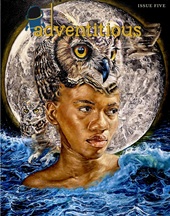 #5, Oct./Nov. 2026
“Burnt Sage and Bygones” by Em Harriett
“How to Understand Each Other” by Emmie Christie
“God in the Vacuum” by Tehnuka
“Sensitive Ice” by Keyan Bowes (reprint, not reviewed)
“Organs of Mortal Obstruction” by H. Marin
“The Gorilla Fighters Under Texas” by Chris Baker
“Starfall” by V.M. Ayala
“The Adventures of Zakar Hussani, Boy Oracle” by Amanda Ilozumba
“Cordyceps Crystal” by Sarah Grace Tuttle
“Last Farewell of the Emperatrix” by Daniel Ausema
“Puddlejumping” by Parker M. O’Neill
“In the Gardens of Allster Hall” by Rebecca Halsey
“New Game Plus” by Abhijeet Sathe
“Ruby Tips to Her Feathers” by Ash Vale (reprint, not reviewed)
“The Big, Cushy Cutie” by Jennifer Lesh Fleck
Reviewed by Wendy Vidlak
Adventitious #5 did not disappoint. A number of well-written, enjoyable stories are found in the issue. Previous reviewers have complained about the explanation of the point at the end of the tales rather than allowing the story to speak for itself. That continued in a couple of cases, but most of the stories avoided the issue. Most of the stories in the issue bring up points of human condition that make you ponder long after finishing the story itself.
In the lyrical tale “Burnt Sage and Bygones,” Em Harriett tells of a man who wakes with no memory or real voice. Normally I dislike second-person stories because they take me out of the story when the character does something I would never do. This one sidesteps the issue by giving the character very few outward choices or personality, a man going through the motions of everyday life. He makes friends in the village who adopt him and he works to earn his keep, but bits of memory tug at the edges, never coming to light. When he regains the memories, does he resume his former self, or does he become a new man? The writing was well done, and I found myself enjoying the tale despite the second-person perspective.
In “How to Understand Each Other,” Emmie Christie tells the tale of two sisters whose mom has passed. The older raising the younger and following the rituals of the culture without knowing why. They dutifully wash their hearts in the river, where strands from deer-cat’s help clean the spots. The oldest sister, Pashi, is given a quest to trade hearts with the river and talk to the goddess in order to cure the river that will in turn fix her sister’s heart. The quest was more emotion than adventure, though climbing a waterfall was perilous. This story worked for me overall as an emotional coming of age piece, but would be a disappointment for someone looking for a classic adventure story.
“God in the Vacuum” by Tehnuka is a very apt description of the short story. An imaginative telling of what happens when a family of immigrants to New Zealand accidentally vacuums up the last small figurine of their god. The story follows the immigrant in their everyday life of tests and work. They are settling in, when the son vacuums up the icon of their god. Then the family fails. The best part was the adventures of the god stuck in the vacuum. A fun piece that debates whether the icon is really a god, or just a symbol, and did the family start failing because they believed the icon or because the icon was a god mistreated?
In “Organs of Mortal Obstruction” by H. Marin a group of monks debate around the table each and every day. They are of no particular order or religion but are debating the essence of God. Until one day they conclude their brains were blocking them from enlightenment and true knowledge of the divine. Brother Wolfgang agrees to keep his brain intact to perform lobotomies on all the other monks so that they may find enlightenment. The well-written piece looks at how men can be led astray in their search for God in any of its many forms. Though not one made to my taste, it is a tale that sticks with you as you ponder whether the mind is really the blockage of enlightenment.
In “The Gorilla Fighters Under Texas” by Chris Baker an eight-year-old who watches the news and doesn’t quite get it, leads to an excellent parody full of puns and other easter eggs those from the 80s would understand. Told by the eight-year-old complete with misspellings and stream of consciousness, this piece holds together with its originality and humor. A surrealistic piece that shows the news has always been subject to interpretation by those who watch it.
After centuries of searching, Vera finds her soul mate, the sword, in the story “Starfall” by V.M. Ayala. The sword made her what she was now and even embedded some of itself into her. The sentient sword Starfall languished imprisoned by the Radiant, who wished to wield the power of the sword himself. The Radiant portrayed as dragons made of flowers currently had vines in all the worlds the two tried to run away to. Fighting for their ability to be together, they fight the Radiant the only way they know how. A classic love story with a lot of adventure set in a multiverse.
A boy with an oracle’s power goes undercover to investigate an evil witch who is running an orphanage in “The Adventures of Zakar Hussani, Boy Oracle” by Amanda Ilozumba. The oracle in the story is more than a future seer, but is a type of magical parasite that fulfills the owner’s wishes to make what they want the future to be come true; sometimes, as with much magic, with unforeseen ramifications. The oracle has a will of its own as well and will take control of the person wielding it to achieve its means. A good coming of age tale with a lot of magic and mayhem thrown in. I found the novelette quite a fun adventure, with a side benefit of great character development.
“Cordyceps Crystal” by Sarah Grace Tuttle is a short flash piece. A crystalized fungus infects a curious girl and sends her on an adventure to beautify the world with her crystals in an attempt to save it from ugliness. A quick piece with a lot of description that I found enjoyable.
Analysis of the paintings that make up “Last Farewell of the Empertratrix” by Daniel Ausema tells the history and politics of a university that transcends worlds through portals into distinct realities. I found it a unique way to tell a story. Understanding a civilization through art. We get a good feel for the politics through the ages by how they portray the last farewell. What the art emphasized, how the Empertratrix appeared in each portrait, student body included or excluded. We are left with a mystery—what really happened to the Empertratrix.
“Puddlejumping” by Park M. O’Neill takes place in a post-apocalyptic world in the near future when money is no longer paid to workers. Instead, you earn whatever the business makes. The main character spends one month on and one month off at a cryogenics factory. Solving problems the AI cannot do itself for the pay of hours in the cryo lab. In her free time, she does medical research. An interesting story of what desperate people do to save others in dystopian times.
“In The Gardens of Allster Hall” by Rebecca Halsey provides a mind-bending exercise in time travel. Taking place in Lady Fiona De la Hay’s English manor built in a time bubble. The modern accoutrements of the world sneak in occasionally, along with Hannah to disturb the idyllic old-fashioned world of nobility and good manners. Lady Fiona leads a cult of participants, one of whom is Hannah’s brother, to escape the current world for a realm of her own creation. The clash of what world is best, modern or historical, with two women on opposite sides creates some fun chaos.
We find Amar sitting in the waiting area of hell in “New Game Plus” by Abhijeet Sathe. The waiting room where people play go fish on the floor until one day they are sucked out of the room and enter into a computer room where they can choose their next life like an RPG game with points awarded or subtracted based on deeds from your past life. A fun story exploring what choices a person would make for their future life given a chance.
In a world set in the not too distant future, “The Big, Cushy Cutie” by Jennifer Lesh Fleck, shows an older woman named Sally seeking a one-night stand. The fantasy life of Sally is full of glitz and glamor as she jumps from gaming to television soaps to dating apps. Living in such a fantasy world, no real person could ever live up to her standards, so she settled for one-night stands. One night, either on a whim or out of desperation instead of going for the superficial choice like she normally does, she picks a genuine nice guy with average looks. What she finds is the guy is a lot more than ordinary. A moral tale on the hollowness of living a superficial life vicariously through electronics rather than looking for genuine experiences.