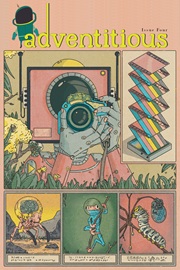
 Adventitious #4, Aug./Sept. 2026
“A Game of Go” by P.A. Cornell
“The Fruit Is Very Acceptable Here” by Kari Maaren
“No Iron Can Resist” by Aimee Ogden
“Mother’s Mother’s Daughter” by Audrey Zhou (reprint, not reviewed)
“Life Imitates” by Rio Lombana & Kaitlin Schmidt
“How to Lose to Death” by Priya Sridhar
“Heartwood” by Moira Richardson
“Saul & Noah’s Hot Bouleutophagy Summer” by Elijah J. Mears
“The Grammar of Jespersen-b” by Holly Schofield (reprint, not reviewed)
“A Hole in My Heart the Shape of the Multiverse” by Ruth Joffre
“The Spacefarer’s Guide to Connecting with Your Daughter’s Descendants” by Stewart C. Baker
“Bath Bomb” by Liam Hogan
“HELLO” by Jeanna Cammarano
“All Aboard” by Hannya Kay
“The Unnamed City, As Seen at Three Points” by Adrian Ward
Reviewed by Malory
I should stress that I really enjoyed a good deal of this issue, and I want to say that up front. There’s a lot of nerve on show in it and several writers who I will eagerly be hunting out to read more from. Nevertheless, the thing I noticed more and more as I went through each story, though, was how many of these writers get to the end and then feel the need to explain to me what their story was about. By the time I’d read six or seven of the stories here do the same thing, it’d gone from an irritating quirk to a regular, unnecessary habit.
“A Game of Go” by P.A. Cornell is narrated by a smart home called Ava who’s raised a boy on her own since a plague took his mothers. The house is now dying of a virus of her own and needs to get the lad out before she herself goes. The bit I liked most here was the metaphor of the boy leaving home meaning leaving Ava’s body, and Cornell gets a lot of mileage out of that. Ava reports heart rates and micro-expressions rather than announcing how she feels, and there’s an uncomfortable stretch where she does something cruel to force his hand. I wasn’t sure I liked her for it (which I think is rather the point). What bothered me, though, was the Go strategy heading over every section. Each of these told me exactly what was about to happen, which felt a touch frustrating. And I really didn’t need the flashing theme line about how in life, as in games, sometimes everything has to be risked. Notwithstanding those last two, this was a well done story.
Then there’s “The Fruit Is Very Acceptable Here” by Kari Maaren, which was excellent. Something that talks to us as “we” is stuck inside a woman called Zoe, who’s noticed it and the two of them are trying to get through brunch with her friends while reality develops cracks around the restaurant. The possession is very effectively handled and the fight over who gets to say “I” is awesome. It’s also a very funny story. “We are not sure what ChatGPT is, though from context clues, we think it is a minor god.” As a minor nark, I did keep waiting for Carol to do something with the fact that she’s clearly the clever one, but, even so, I absolutely loved this.
“No Iron Can Resist” by Aimee Ogden is a monologue from a woman doing penance in iron rings for dancing on top of the Stevenskerk tower with her demon lover. It’s addressed to a girl the priest has sent to be warned off about such things, but said warning becomes an invitation. The problem for me is that this is a monologue and nothing more. The girl never speaks, never pushes back, and the “nothing lasts forever” refrain gets one more airing than it needed.
I’m afraid that “Life Imitates” by Rio Lombana & Kaitlin Schmidt is the story I got on with the least. Mari wakes up to find her wife Karley cooking roadkill and explaining various other horrors away in the language of self-help. “I am not disgusted. I am supportive” is a pretty fun joke. The problem is it’s a single joke and the story beats it to death. At length. For several thousand words.
“How to Lose to Death” by Priya Sridhar is a numbered set of instructions for losing a wager to Death. The list starts off jaunty and then goes somewhere else, and I found myself quite unsettled by the whole thing. I would flag, though, that in the middle is the same drink-and-lose beat repeated which seems to be there purely to pad things out. Nevertheless, it was the oddity of the whole thing that stuck with me and I enjoyed it immensely.
“Heartwood” by Moira Richardson is about a woodsman convinced there’s a nymph lurking inside an oak which, of course, he decides needs carving out. It’s very clear that Richardson knows their wood, and the smells of the trees suffuse the whole text in the most wonderful way. This is also an example of an unreliable narrator done very well indeed. This was another issue highlight and one that wasn’t afraid to make demands of the reader.
Which brings us to “Saul & Noah’s Hot Bouleutophagy Summer” by Elijah J. Mears which is the story that swung hardest for the fences. In it, we learn that Americans have started eating their elected representatives. Entertainingly, Mears has laid Genesis over the top of it, so we witness a country getting taken apart in the same words that made it, which I found to be very sharp. And I also enjoyed a dead councilwoman’s rugelach recipe doing the rounds alongside deepfakes of her at the barricades. When I reached the end, this was probably the most comfortable about cannibalism I’ve ever felt!
“A Hole in My Heart the Shape of the Multiverse” by Ruth Joffre is a letter from a geographer who’s been stuck for years in a house of doors between worlds. She’s writing to another version of herself and the control of the prose here is, by far, the best in the issue. I especially liked the imagery of the overlapping miniature doors, where the choice to open one makes half a dozen others now off the table. Where it did let me down a touch, though, is that I couldn’t shake the feeling that the story was more of a catalogue than a plot. In fact, the one scene that’s actually properly dramatised comes very early on in the piece and we never go back to it.
“The Spacefarer’s Guide to Connecting with Your Daughter’s Descendants” by Stewart C. Baker has a lightspeed trader arguing with her daughter followed by a twenty-five-minute pursuit that costs ninety years. Sadly, the title pretty much announces where all of this is going. It’s fine but, you know…
On the other hand, “Bath Bomb” by Liam Hogan made me laugh out loud several times. The salesman’s skull perched on the chair was a lot of fun, and it was a real pleasure to be in the hands of a writer who knows how to keep track of their setups. The peacock suit, the vanished mallard and the coal bucket all get their beat later in the piece and the gags all land. What did wear me down a touch, though, is that the narrator was incapable of finishing a joke without then adding a much weaker one in brackets straight after it. This tic meant that the tale’s all a touch too long for the fun and ends up slightly overstaying its welcome.
Without question, “HELLO” by Jeanna Cammarano has, by far, the best idea across the issue. In it, we meet an imprisoned mage who’s had her fingers broken so that she can’t draw runes. But she then starts seeing incomplete runes glowing on the wall. The idea that a broken form of any given spell might run off an alphabet of its own is a fantastic one, and I found the little rune glosses between sections to be all neatly done. This was a small, fierce piece that means I’ll be keeping an eye out for the author.
“All Aboard” by Hannya Kay has four crew members adrift after their ship explodes and a spinning object drifting towards them that shows the narrator her mother. The story’s in four parts, each opening on the same beat, with a minor something changed between the beats. Sadly, I couldn’t work out whether we were meant to believe the narrator or not. And I don’t think the story knew either…
Finally, we reach “The Unnamed City, As Seen at Three Points” by Adrian Ward which is all about a traveller telling their kid about an uncharted city. Ward crafts some truly lovely sentences, and the moment about the rat and the cat and the smell of something simmering made the emptiness of the place feel wholly tangible. My difficulty with the piece, though, is that almost nothing happens, everything that does happen gets hedged into ‘maybe’, and, once more, the meaning of the whole thing is heavily signposted.
Overall, my irks with this issue were that we had multiple stories that were doing just fine until they stopped being good to explain themselves. The stories were right there on the page and the writers should’ve trusted their readers to interpret them. For me, Maaren, Cammarano and Joffre, all took big, risky chances with their plots and mostly landed them. I’m glad I read these, though, and would encourage all concerned to risk ambiguity rather than playing it safe.