What the Universe Keeps
by
Manjula Menon
“To see a world in a grain of sand
And a heaven in a wild flower,
Hold infinity in the palm of your hand
And eternity in an hour.”
William Blake, Auguries of Innocence (1803)
∞ ∞ ∞
My husband, the philosopher Anand Vaidya, died of complications due to cancer in October 2024, at the age of 48. The tension between what I feel to be true and what I can intellectually defend has grown increasingly difficult to dissolve since then.
Anand, drawing from Indian philosophical traditions, often argued for expanding what counts as responsible epistemology to include mental states. He held that there is a fundamental role for the “sense of self” or “consciousness”, not merely as a tool for understanding, but what ultimately needs to be understood. While I’ve grown increasingly sympathetic to this line of thinking, I still find myself at an impasse between hope and delusion. This essay is one of a series where I aim to ease that tension. Here, I explore the notion of infinity as it relates to the size of the universe and what that says about identity as a conscious self. I draw primarily from the field I am familiar with, physics, but also from mathematics, Indian philosophy and science fiction.
Mathematical Truths:
To paraphrase the seventeenth-century astronomer and physicist Galileo Galilei, nature is God’s book, and it is written in the language of mathematics. Galileo’s point was that understanding reality requires mathematical literacy, given the extraordinary ability of mathematical abstractions to describe and predict empirically verified phenomena. This raises the question of whether mathematics is discovered as a feature of reality or invented as a framework for describing it.
The ontological status of mathematics and whether abstract mathematical notions exist as mind-independent realities has been long debated by philosophers. Plato, for example, suggested mathematical concepts were real, in that they could be employed to point towards metaphysical truth. In contrast, Ludwig Wittgenstein argued that mathematical concepts should not be understood as abstract entities that exist independently of human beings, but that they derive their meaning from their role within human language, as a framework for how we reason about and describe the world.
The 18th century philosopher Immanuel Kant came out somewhere in between, arguing that mathematical concepts were “synthetic a-priori”; for example, we intuitively know Euclidian stuff like the shortest distance between points is a straight line without having to derive it empirically. Kant specifically addressed the notion of infinity as it relates to the size of the universe. He held that there were compelling reasons for space to be infinite, but equally compelling reasons for it to be finite; he thus relegated the question of whether the universe is infinite in size to an “antinomy”, or logical impasse.
Science fiction writers have also grappled with the strange implication of mathematical abstractions. For example, H.G.Wells wrote about Time as a fourth dimension, one that with the right technology, we could traverse just as easily as we move through space. Likewise, Edwin A. Abbott’s Flatland explored how beings embedded in different dimensions might experience reality (Abbott, 1884).
As truth-constrained as mathematics appears, few would disagree that there is much in it that is not intuitive, including its most basic building block: numbers. In addition to the familiar class of real, rational and irrational numbers, there are also “imaginary” numbers like the seemingly impossible quantity √-1. These imaginary numbers form the basis for “complex” numbers, which are indispensable to modern physics.
The philosophy of mathematics had been one of Anand’s many interests. I remember a hike we took in Marin one foggy morning. I remember the ascent through wet woods, being careful about the slippery rocks that lined the trail after the previous night’s rains, the faint scent of slushy eucalyptus leaves, and the mushrooms we stopped to inspect. I remember we talked about Zeno’s paradox and about Georg Cantor’s (1895/2021) work that proved the notion that not all infinities are equal. I can picture Anand in his dark anorak and muddy boots, his body aquiver and his voice loud with excitement about the points he was making. I would very much have liked to have shared those points here, but hard as I’ve tried, I fail to remember them. If I was to guess, it was likely that he was making a similar point: mathematics helps reveal truths about reality yet is full of concepts almost impossible for us to imagine.
Cosmology and the Infinite Universe:
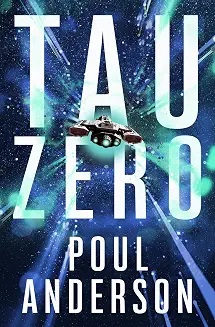 Poul Anderson’s Tau Zero (1970) tells the story of the crew aboard the starship Leonora Christine, propelled by a Bussard Ramjet. The Ramjet uses a propulsion method that allows for relativistic speeds by scooping up interstellar and intergalactic hydrogen that undergoes thermonuclear fusion and is expelled for thrust. However, a malfunction takes away the ability to decelerate; the crew decide to try to accelerate their way out of their predicament, hoping to run out of fuel in the great voids between galactic systems. And so the Leonora Christine screams its way across the universe at velocity approaching c, the speed of light, and with the time contraction factor, the titular “tau”, approaching zero. With tau at near zero, a moment is all one would experience to travel the entire width of the universe; at tau=zero an infinite expanse can be traversed in an instant.
Cosmology rests primarily on physics, and therefore mathematics. While infinity is not considered a number in standard mathematics, the notion of infinity is central to physics. Till the beginning of the 20th century, cosmologists favored a finite universe. Then in 1929, Edwin Hubble showed that distant galaxies recede faster in proportion to their distance, establishing that the universe is expanding. The precise rate of expansion, encoded in the Hubble constant, remains contested, with measurements from the early universe using the cosmic microwave background (CMB), and the late-universe measurements using standard candles like cepheids, disagreeing in what is now called the “Hubble Tension” or even “The Crisis in Physics.”
Tau Zero was published when the prevailing cosmological theory was “The Big Crunch” which described the universe as succumbing to the attractive force of gravity and eventually collapsing into a singularity. The current standard theory of cosmology, Lambda Cold Dark Matter or ΛCDM, explains the accelerating expansion rate of the universe by postulating a repulsive counterweight to the attractive gravitational force of regular matter, a mysterious “dark” quantity comprised of dark matter and dark energy. Unlike its “regular” counterpart, this dark substance maintains a uniform density even upon expansion and does not interact electromagnetically. It appears susceptible only to the attractive force of gravity from itself. ΛCDM posits that over 95% of the universe is comprised of this mysterious quantity.
In 2018, the European Space Agency’s (ESA) Planck satellite confirmed a flat geometry which points to (though doesn’t prove) a universe that is infinite in spatial dimension. Cantor’s seminal work proved that there are a hierarchy of infinities. This non-intuitive idea becomes clearer if we compare the set of even numbers with the set of real numbers. Both are infinite, yet the set of real numbers is provably larger. Paraphrasing the physicist Roger Penrose, we can thus think of infinity as a place, a Cantoresque boundary of infinite size, that photons, traveling at the speed of light, and for whom tau is always zero, will reach instantaneously.
Whether the universe is finite or infinite may be permanently unknowable to us, bounded as we are by our particle horizon, but the notion of an infinite universe, if true, opens the door to strange possibilities. In an infinite universe, the probability is unimaginably small, but non-zero nevertheless, that the Schrödinger equation that describes the evolution of the state of all physical systems, will repeat exactly for every subatomic particle that exists in the local part of the universe. Another localized region will produce another big bang, one in which every atom in every star and every photon racing towards infinity, will encounter exactly the same phenomena as did ours, and will interact in exactly the same way, such that a star exactly like our sun will form, and in orbit around it, a rocky planet exactly like Earth will arise, and billions of years of evolution will result in a species exactly like us. An infinite universe implies that anything with a non-zero probability will happen. In an infinite universe, history doesn’t merely rhyme, it repeats. As in exactly, word for word, moment for moment. These are not merely cosmological curiosities. They now bear directly on the question of whether Anand’s loss should be understood as absolute.
As speculative as these notions appear, they are based on the laws of statistical mechanics and probability in line with physics. But additional questions arise when one introduces the notion of the “conscious self” or “consciousness.”
Identity and Consciousness in an Infinite Universe
The currently dominant view of consciousness known as “physicalism” posits that consciousness arises from purely physical processes, for example by complex computation as described by Tononi’s integrated information theory (IIT) or due to quantum processes in the brain as per Penrose and Hameroff’s orchestrated objective reduction (Orch-OR). Alternatives to physicalism hold that consciousness cannot be explained through purely physical processes. Even if we take physicalism to be true, however, questions about identity persist.
Consider the example of the Star Trek transporter. While the transporter works by transporting atom by atom, pattern for pattern, at the entry point and reconstructing it at the exit, malfunctions result in, for example, multiple “copies” of the original. The conceit here is that identity is relational and not absolute. Identical patterns of atoms, along with all relevant vectors and variables that describe the physical system that is a human being at a moment in time, is dismantled and then reconstructed elsewhere and is taken to be the same person. Derek Parfit pushed this line of reasoning further. He argued that personal identity consists in nothing more than these chains of physical and psychological continuity, and that there is no further, separate “identity” over and above them. For Parfit, continuity, and not a separate fact of “identity”, is what matters (Parfit, 1984).
There is no causal connection between the identities, yet they would be identical. What could it mean for one identity to be distributed across the infinite universe? A speculative possibility could include a single consciousness being expressed through each “avatar”, experiencing simultaneously every possible outcome at every possible time, every possible solution of the Schrödinger wave equation. These no longer feel like mere cosmological curiosities for me.
 A speculative consequence of an infinite universe is the “Boltzmann brain”: a spontaneous fluctuation into consciousness, complete with false memories of an entire life. The skeptical claim to the ideas I’ve been pursuing is that such a momentary fluctuation is vastly more probable than a causally coherent recurrence of Anand with a real evolved history. Indeed, under this account it is far more likely that I am not typing these words at all, but am instead a momentary fluctuation into consciousness, complete with false memories of having written them. The Boltzmann brain, however, is only a challenge under certain theories of consciousness, like IIT, where consciousness tracks integrated information in a configuration regardless of its causal history. But as counter examples, Orch-OR requires biologically embedded quantum processes that a momentary fluctuation cannot instantiate, while panpsychism takes consciousness as fundamental rather than an emergent property of any brain-like configuration.
Another notion of identity is indexical: there may be infinite copies or versions of a pattern, but each is unique. There is haecceity, or “thisness” to each version, even if they are the same, atom for atom, pattern for pattern. Note that in either case there is no causal link; the infinity that separates the identical patterns cannot be breached, as the distances that information, traveling at light speed, is greater than would allow for causal continuity.
What, if anything, persists after death is not a question that is taken to fall within the realm of physics. The question, however, is related to whether the universe preserves information; and here, physics has an answer. In quantum mechanics, the law of conservation of information (unitarity) as demonstrated by the “no-hiding” theorem in 2007 and experimentally verified in 2011, dictates that analogous to the laws of momentum and energy, physical systems preserve quantum information.
The empirically derived 2nd law of thermodynamics dictates that the entropy of an isolated system will always increase over time. Due to the 2nd law of thermodynamics, this information becomes so scrambled and entangled with the environment that to extract it to reconstruct the past is practically impossible. In other words, while the universe can be strictly preserving information, there is no practical way to extract and reconstruct it.
Roger Penrose’s CCC, “Conformal Cyclic Cosmology,” (Penrose, 2012; Meissner & Penrose, 2025) proposes that the universe consists of an endless sequence of “aeons,” where the extremely remote future of one aeon becomes, after a conformal rescaling, the Big Bang of the next. Penrose suggests that gravitational-wave-related information might leave observable traces from a previous aeon in our universe.
Science fiction often uses the notion of identity or self as preserved over time. For example, a major plot line of Frank Herbert’s seminal novel, Dune, is the ability to “remember” the lives of ancestors, suggesting that experience itself is preserved.
Even if an exact duplicate of Anand could exist, does it matter? A skeptical response presents itself immediately: even if an infinite universe guarantees that an identical pattern recurs somewhere, that future Anand would merely be a copy. On the other hand, continuity may matter more than pattern.
To see where my own intuitions fall, I considered the speculative scenario where I would come face to face with another Anand, somewhere in the infinite stretch of space and time. I would know, of course, that this was not substantially my Anand. And yet, I think I would feel like he was, resulting in the same predicament I am in currently, at an impasse between what I know and what I feel to be true.
A View from Vedanta
If the physicalists are right, then the same processes that gave rise to Anand’s consciousness in this corner of infinity, can do the same in another place or time, atom for atom, moment for moment, such that an exact physical duplicate arises. That there are infinite versions of Anand, separated by infinitely large distances or durations, means that in some of those instances, Anand didn’t die young. A pessimist would point out that in addition to the best case scenarios, there are an infinity of other, far darker, possibilities for how his life might have turned out.
These are all physicalist takes, where consciousness is taken to arise from physical processes alone. However, Anand himself aligned with the notion that consciousness is more accurately understood through the lens of Indian philosophical traditions.
One of the last pieces Anand worked on before he died explored notions of self from Advaita Vedanta (I am co-author, though the ideas are mostly his). Śaṅkara and Rāmānuja represent two poles within Vedanta that bear directly on the identity question raised earlier. For Śaṅkara, individual selves are not genuinely distinct from this universal consciousness; their apparent separateness is the product of ignorance: Atman=Brahman. Incidentally, this is the philosophical interpretation of consciousness favored by the physicist Erwin Schrödinger, as he argues for in a series of abductive moves in a brief epilogue to his seminal What is Life? (1944).
In Śaṅkara’s account, the question of whether a recurrence of Anand’s pattern would be “the same person” dissolves. For Rāmānuja, consciousness is irreducibly relational and always tied to individual selves, always directed at objects, and always structured. On this view, haecceity is not an illusion to be overcome but a genuine feature of reality. The tension between these two positions somewhat imprecisely maps onto the tension between pattern-based and continuity-based theories of identity I described earlier. Śaṅkara dissolves the problem by denying the ultimacy of individuation while Rāmānuja insists that individuation is real and cannot be explained away.
The contemporary writer David Mitchell’s Cloud Atlas is the story of a single identity that experiences life as different people across vast expanses of time. Mitchell construed it as a single soul undergoing reincarnation. Note the words “soul” and “reincarnation” are linked to spiritual traditions like Vedanta and resonate with the concepts I have been exploring.
Contemporary philosophy of mind is increasingly confronting the “hard problem of consciousness,” which asks to explain why physical processes give rise to experience. One increasingly prominent response to the hard problem is panpsychism. This is the view that consciousness is not produced by matter but is itself fundamental. As Anand wrote, the real hard problem is no longer explaining phenomenality but explaining the self: how does a single, universal consciousness differentiate into first-person perspectives of individual subjects? (Vaidya & Siddharth, 2026).
In the Advaita Vedanta version of reality, one of two things has happened. When Anand died, his “jivatman”, the self that undergoes the cycle of death and rebirth, was or will be reborn as another life form in the infinite universe. What kind of life form will depend on his karmic load, viz how he lived and interacted when he was Anand. He will forget that he ever was Anand, but I imagine would approach his new life with the same generosity of spirit, kindness and ambition that he brought to this one.
The second option is that during this life, he was able to realize the deepest nature of consciousness, the subtlest of subtle signals: the Atman. This is described as only being available to those who engaged in relevant intellectual pursuits such as philosophy, and who’d lived an ethical life, both true of him. Whether he was able to “grasp” the subtle signal of his own Atman before he died, and therefore be free of the wheel of samsara, or the cycle of birth and death, will remain unknowable. Though I told him when he lay in his hospital bed that if anybody could do it, it was him.
REFERENCES:
Abbott, E. A. (1884). Flatland: A romance of many dimensions. Seeley & Co. https://archive.org/details/flatlandromanceo00abbo_0/page/3/mode/1up
Anderson, P. (1970). Tau Zero. Doubleday.
Benacerraf, P. (1973). Mathematical truth. The Journal of Philosophy, 70(19), 661–679. https://doi.org/10.2307/2025075
Braunstein, S. L., & Pati, A. K. (2007). Quantum information cannot be completely hidden in correlations: Implications for the black-hole information paradox. Physical Review Letters, 98(8), 080502. https://doi.org/10.1103/PhysRevLett.98.080502
Cantor, G. (1895/2024). Contributions to the founding of the theory of transfinite numbers (J. R. Meyer, Trans.). Retrieved June 2, 2026, from https://jamesrmeyer.com/infinite/cantor-contributions-transfinite
Galileo, G. (1957). The assayer. In S. Drake & C. D. O’Malley (Trans. & Eds.), The controversy on the comets of 1618 (pp. 183–283). University of Pennsylvania Press. https://archive.org/details/controversyoncom0000unse/page/151/mode/1up
Hubble, E. (1929). A relation between distance and radial velocity among extra-galactic nebulae. Proceedings of the National Academy of Sciences, 15(3), 168–173. https://doi.org/10.1073/pnas.15.3.168
Penrose, R. (2012). The basic ideas of conformal cyclic cosmology. AIP Conference Proceedings, 1446, 233–243. https://doi.org/10.1063/1.4727997
Meissner, K. A., & Penrose, R. (2025). The physics of conformal cyclic cosmology. https://doi.org/10.48550/arXiv.2503.24263
Vaidya, A. J., & Siddharth, S. (2026). Rāmānuja’s cosmopsychist-panentheistic solution to the hard problem of consciousness. Religious Studies, 62(S1), S65–S81. https://doi.org/10.1017/S0034412525100838
Parfit, D. (1984). Reasons and persons. Oxford University Press.
Vaidya, A. & Menon, M. (2023, January 15). How classical Indian philosophy helps us understand the self. Aeon. https://aeon.co/essays/how-classical-indian-philosophy-helps-us-understand-the-self
Wells, H. G. (1922). The Time Machine. Internet Archive. https://archive.org/details/wells-1922-time-machine/page/n3/mode/1up
Wittgenstein, L. (1974). Philosophical grammar (R. Rhees, Ed.; A. Kenny, Trans.). University of California Press. https://archive.org/details/philosophical-grammar-by-ludwig-wittgenstein-z-lib.org/mode/1up
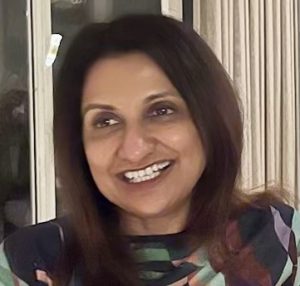 Manjula Menon is a writer whose work explores the intersections of science, philosophy, and speculative imagination. Her recent essays include “The Science Fiction and Philosophy Society: An Introduction” in Sci Phi Journal and “Sea and Space Laws” in Amazing Stories. Her fiction has appeared in Nimrod International Journal, North American Review, Santa Monica Review, Pleiades, Southern Humanities Review, and Tampa Review, among others. Her honors include a Yaddo Fellowship, a Bread Loaf Writers’ Conference waitership, and a Writing Downtown Fellowship in Las Vegas.
Trained in astrophysics and electrical engineering, she has been part of the founding teams of two technology startups, worked at a major New York consulting firm, and designed cellular networks internationally. Her current work examines questions of consciousness, intelligence, and the ways science fiction shapes our understanding of reality.
Menon was born in India, and spent part of her childhood in Zambia. She lives in San Francisco.
All text copyright © 2026 Manjula Menon
All Rights Reserved.