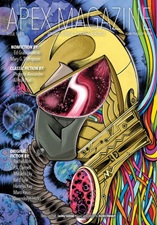
 Apex Magazine #155, November/December 2026
“Rosewater” by Rachel Alm
“Compliance” by P.A. Cornell
“They Calls Me Freedom” by Malachi Lily
“Heartrending” by Kel E Lyle
“One Two Three” by Hannya Kay
“Beyond the Edge of the World” by Maro Reus
“A Lullaby for Dying Fish” by Gwendolyn Hicks
Reviewed by Markus Weimer
Apex Magazine #155 contains two reprints alongside seven original pieces of short fiction: four conventional-length stories and three flash pieces. These seven stories repeatedly bring the strange and surreal back to something recognizable: care, agency, grief, survival, and the strange things we do to preserve the people we love. They are serious yet bizarre, human and complex, but emotionally legible. If you enjoy speculative fiction, this is a good issue to dip into. The only prerequisite is a willingness to let the tropes bend.
The standout for me is “Rosewater” by Rachel Alm. Its central character is a witch who has been made into a beast, both by others and by herself. Children call her “little witch”; she sees them as animals that “hunt in packs.” Then Marshall arrives at her door, bruised and with a cigarette burn in his shirt, and she lets him in. The monster, it turns out, is not necessarily the most dangerous thing in the woods.
Alm’s use of blood is what stayed with me. The roses “smell like blood,” and the narrator feeds them blood from her food. They are the remains of the woman she loved, preserved through something taken from the present. When her lover is murdered, the narrator discovers that cruelty is “mine to call on too.” She becomes the beast everyone imagined, burying the hearts of her victims beneath the roses.
Marshall offers another possibility. He lies, hurts her, and eventually helps destroy the roses, but she begins to care for him anyway. When he asks how the roses grew, she says only, “Patience.” The narration adds: “More than patience, of course. Practice. Love.”
That feels like the heart of the story. The narrator has spent years preserving her dead lover by feeding her grief with blood. Marshall suggests that something can be kept alive without being fed a wound.
If “Rosewater” asks what we do with grief, “Compliance” by P.A. Cornell asks what happens when we try to give someone else the freedom we were denied. Jessa has escaped a society where children are implanted with devices that make them compliant. She returns for her younger sister, Thea, and tells her, “Come here.”
She does so.
There is no struggle because there cannot be one. Jessa has reproduced the very thing she is trying to escape. Her parents believed obedience was safety and called it freedom. Thea has “not the slightest idea what freedom meant.”
What I like is that there is no clean answer. Jessa has to choose for Thea in order to free her from a system that has already chosen for her. Can you give somebody freedom without making a decision on their behalf?
Freedom is not simply what happens when the door opens. Sometimes it is the frightening moment when nobody tells you what to do next.
“They Calls Me Freedom” by Malachi Lily complicates that question by asking what happens when care itself becomes entangled with control. Freedom is a young child in the Florida swamp who finds Big Easy tangled in mangrove roots and believes the strange figure to be a fish spirit. The adults recognize what Freedom cannot: Big Easy is a domestic medical android.
Big Easy has “skills of care,” but that care has been servitude. It tended to the bodies of uploaded humans while they lived inside augmented realities, never free to choose that role. Freedom, meanwhile, wants to understand Big Easy on their own terms.
The story makes an interesting companion to “Compliance”; both ask what freedom means when somebody else has already decided what you are for. But here the uncomfortable question is whether care can itself become another form of control.
“Heartrending” by Kel E Lyle makes bodily ownership literal. In this world, marriage requires couples to exchange hearts. The narrator does not want to give up hers, but everyone tells her she must. “You have to. Everyone does.”
The heart is a metaphor made physical. After Ophelia dies, the narrator cleans blood from wedding chapels and operating tables. Eventually she discovers people secretly exchanging hearts before marriage.
Her rebellion comes from love. She is willing to give up her own heart so Camille can have a life the system says she cannot have. The difference is that this time, she chooses.
The story understands something important about autonomy: refusing to surrender is not the only way to reclaim it. Sometimes the choice is in deciding what you are willing to give, and to whom.
“One Two Three” by Hannya Kay is more immediate. Shana is injured, moonwolves surround the bunker, and the narrator keeps counting because counting is something she can control.
One, two, three. Breathe.
The story makes survival feel small rather than heroic. Sometimes survival is simply doing the next thing, then the next thing. But as the world becomes increasingly impossible to understand, even the counting begins to change. The moonwolves become sunwolves; the narrator wonders whether some of the creatures are actually the colonists themselves. By the time she reaches the shuttle, the counting has fused into: “Oneoneone… twotwotwo… threethreethree…”
The language itself begins to lose its boundaries. What starts as a coping mechanism becomes almost compulsive. It is a tiny story about the desperate need to find one thing we can still control when everything else has become frighteningly uncertain.
“Beyond the Edge of the World” by Maro Reus may be the story I found most beautiful. A marooned pirate is waiting to die, but what frightens him most is loving someone whose body can die.
“Never known terror ’til I loved her.”
He turns her body into a map, imagining her freckles as constellations and thinking in terms of “heart cartography.” Like the witch in “Rosewater,” he wants to make something mortal permanent.
His pistol does not fire because she has removed the lead shot. She appears beside him holding it and tells him she has a need to teach him the stars.
I loved that ending. It does not solve death. It gives him something to do while he is alive.
Finally, “A Lullaby for Dying Fish” by Gwendolyn Hicks brings the issue’s ideas down to almost nothing. Three enormous colossi approach the narrator’s village. Everyone else has fled, but she stays. She knows she cannot stop them. She stays to witness.
When she lifts a dying fish from the water, she realizes that, from its perspective, she must look enormous too. She sings to it as it dies.
It brought me back to “Rosewater.” What can you do when you cannot save something?
You can feed it. You can carry it. You can tell it a story. You can sing. You can stay.
That seems to me to be what connects these seven stories. They are all, in different ways, about what we do when we cannot completely control what happens to us or to the people we love. They ask what belongs to us: our bodies, our choices, our memories, our grief, the people we love. Perhaps the more interesting question is what we do when we realize that none of these things can really be possessed.
We can only tend them for a while.
“Rosewater” is my favorite, though “Beyond the Edge of the World” is the one I wanted to read again almost immediately. “They Calls Me Freedom” has the most interesting world and voice, “Heartrending” has the image I am least likely to forget, “One Two Three” is probably the most fun in the moment, and “A Lullaby for Dying Fish” is the smallest story that leaves the largest shadow.
But I keep coming back to the roses.
Perhaps because the best speculative fiction does not ask us to imagine another world. It gives us another way of looking at this one: a choice that is not really a choice; a machine built to care for others that wants to be free; a woman who stays behind to sing to dying fish; a pirate saved not from death, but from dying before he has finished looking at the stars.
And a witch who learns, very slowly, that keeping something alive does not have to mean feeding it blood.