“1up” by Scott Steensma
“We of the Zom” by Greg Foyster
“Alacrity (For Glenda)” by Stephen Higgens
Reviewed by Wendy Vidlak
“1up” by Scott Steensma takes the video game trope of multiple lives and makes it real, with one catch: only one do-over. Seb, the protagonist, does parkour to make his way through school. Made invincible by an implant that allows him one life, and so long as the implant flashes green, he knows he cannot die or get seriously injured. A major benefit for a guy who jumps off buildings for a living. Everything changes one night at a party when he tries to jump between two buildings when drunk and falls 5 stories to his first death. The implant works but now flashes red. No more reset life for him.
An interesting story that explores the psychological changes that occur when you believe you are invincible versus you could die at any time. It looks at the transformation from one to the other and the inevitable anxiety and caution that suddenly arise from having only one life left. It provides an interesting interplay of personality between when he was a parkour star afraid of nothing, to after when crossing the street produces mass anxiety. The author did a good job showing the personality changes that occur from just this one event. Three seconds of his life erased, so that he could have a second life. The question becomes which life is better for him, and is he a better person in his first life or his second?
“We of the Zom” by Greg Foyster, written in the first person, starts with the protagonist meeting up with his friend Jax at a Churro restaurant. His friend gives him a proposition: use the money you inherited from your father to invest for a 90% return rate. He watches the operation as they talk and notices the older employee walking around like a zombie. He watches them when Jax calls out that it was time to retire. The worker moves to a table with 4 other workers sitting there inert. He takes out what looks like his tongue and puts it into one of the other workers’ mouths. They suddenly get up and start working.
Jax continues his business pitch, saying that he has 100% employee retention, and they work for almost nothing and never miss a shift. He said the churros are made from all the normal ingredients with one addition, a secret additive that he will only reveal once the protagonist is in. A few days later, he signs the nondisclosure and finds out it was a yeast ball that was passed from one employee to another. Eaten raw, it changes the employees so that they are completely obedient and happily work for less money if provided the raw churro dough containing the yeast.
The entrepreneurs decide to rebrand the restaurant with a zombie theme and bring in a makeup artist to complete the effect. They then lean in on the fact that the yeast is a potent drug that makes people into zombies of a sort, one that is becoming quite popular. The protagonist wonders what it is like, but doesn’t try it for fear of addiction until one night when he accidentally bumps into the makeup artist. Then, we find out the real story behind the yeast. This story looks at a different type of psychological transformation when you drop the worries of the world, but stumble around like a zombie.
The final story in this issue is “Alacrity (For Glenda),” by Stephen Higgins. We see Keith as he walks into his sister’s memory care facility, or at least that is what we are made to believe, since it is told from Keith’s viewpoint. He talks about her diminishing capacity and cites instances of how things are not going great for her. How he should be mindful of her memory gaps and lack of detail. How she doesn’t recognize herself in the mirror. Yet her speech and bearing are much like they always were. As an aside, he mentions that she speaks better than he does. The story relies on details that keep changing. As they change, we realize that what we are seeing through Keith’s eyes may not in fact be the full truth. By the end, the reader is not sure what part of the story was the truth. Are the changes in the two people with dementia, or is there something supernatural going on in this facility? The story is one that requires close reading to find the details that change and give hints about the actual outcome.
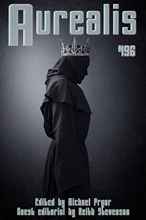
Overall, I enjoyed this issue of Aurealis. Playing with the psychological themes works well in the stories. “Alacrity (for Glenda)” will stay with me for a while as I try to figure out what really happened. “1up” lets us explore how much risk and risk aversion affect our lives. “We of the Zom” while having a psychological bent, asks if the stoners are the enlightened, and was mostly a fun tale.