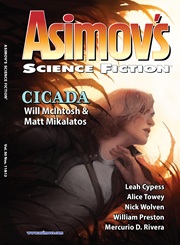
 Asimov’s, November/December 2026
“Cicada” by Will McIntosh & Matt Mikalatos
“Sort” by Alice Towey
“Remnant” by William Preston
“A Soul Unearthed” by Gregory Marlow
“The Water Gods’ Treasure” by Anya Ow
“Nothing I Like To Do Pays Well” by Peter Wood
“Rocket Jock” by Nick Woven
“…Even Kings” by John Richard Trtek
“Night Beach” by Mercurio D. Rivera
“How To Write A Suicide Note” by Leah Cypess
Reviewed by Henry Gasko
I haven’t read Asimov’s for some time and was looking forward to some unadulterated science fiction, in the tradition of the magazine’s namesake. But in fact the latest issue begins with “Cicada” by Will McIntosh and Matt Mikalatos, a straight up horror story. Mysterious entities called Cicadas attack like clockwork every four hundred and twenty-seven days, entering our world in a different but ghastly form each time. They appear out of fifty or sixty “portals” in random places around the world and they can only stay for a few hours before they have to rush back into their portal. There is no reason, scientific or paranormal, given by the authors for the creatures appearance or motivations or the trumpet calls that herald their arrivals, a major failing that saps the story of any possible thematic resonance. And the Cicadas seem to have a particular interest in only one person, the main character of the story Diana, again for no reason that is given or even hinted at.
Much of the story involves the dynamics of Diana’s extended family as they gather at a cabin by a frozen lake to wait out the creatures next scheduled appearance. This reader was expecting some important insight from the family’s interactions as they debate whether Diana really is a target or has simply been unlucky during the previous invasions. This sense of something important about to be revealed was heightened by the fact that Diana has an aunt called Diane. Having two characters with such similar names would normally be a huge no-no in a piece of fiction unless there was some deep significance to the similarity. But there is nothing particularly interesting about the family’s debates and no indication that the coincidental names are anything other than perhaps the artifact of two different authors working on the same story. The confrontation with the alien, when it finally arrives, is satisfying enough but fails to make up for the lack of any background or rationale for the creatures or their fixation on Diana.
Even in an era where AI’s and robots are often assigned human characteristics, “Sort” by Alice Towey is one of the most anthropomorphic bots you will find in fiction. Sort, a trash sorting robot, misses its inoperative companion bot, laments the inaction of the maintenance crew, and wallows in self-pity while contemplating the amount of work it has to get through. So it is no surprise that, when a young child enters its yard running from pursuers, Sort is immediately helpful even to the point of endangering itself. From there, the story’s unsurprising plot, told in unexceptional prose, plays out exactly as you would expect.
“Remnant” by William Preston is an eleven thousand word novelette that somehow seems even longer. The prose is detailed and flowery, reminiscent of Jack Vance in some ways: a human world that seems alien, characters masking themselves in ways that the author clearly intends to be revealing, and ancient technology whose purpose as well as its operation is lost in the mists of time.
The story opens with an Overseer, Vanda, recording her daily activities by speaking into the walls of her home, taking care to be as precise as possible: “Of what value was the past without a foundation in fact?” And this emphasis on truth as the primary factor in the stories we tell ourselves is the main theme of the story.
Vanda’s world is disrupted when groups of citizens begin to congregate at the top of a local hill, experiencing a different deep emotion every evening, only to return home with no memory of the event. She calls on several friends and experts to investigate, a laborious process told in excruciating detail that leads them into the archives. Here historians attempt to record the complete true history of their world in an effort that one character calls “a monument to the impossible.” There are long discursive info-dumps about the evolution of their language and their written symbols, what lies buried under the hill, and the forgotten technology that is driving a few people to overwhelming visions while leaving most of the citizens unaffected. The ending, while somewhat ambiguous, implies that perhaps truth is not the unalloyed virtue it might appear to be.
“A Soul Unearthed” by Gregory Marlow is a story that is attempting something much more ambitious: the question of what is a soul. The main character, Cedric, is hired under strict secrecy by the government to operate an earth mover. Cedric has been interested in things that live underground since childhood, and has often speculated about the soul of the creatures that he uncovered. Now his job is to unearth a gigantic form that may be a body. While working on the dig, he sees the apparition of a young girl who eventually shows him the scale of what he is uncovering and leads him to question the place of souls in the overall scheme of the universe. This is a well written and thoughtful story, though again more metaphysics than Newtonian or even Einsteinian physics.
“The Water Gods’ Treasure” by Anya Ow is a very short non-story that reads more like the introduction to a longer work. It is set in New Singapore, part of a hot and humid after-climate-change sort of city where everything is run by AI’s, even the machinery for some reason still has to be fixed by young technicians wading through the sewers in out-of-date diving suits. Isla, a technician fixing her first breakdown, is also the grand-daughter of one of the founders of Shuixian-3, the machine that runs the system. But her grandfather’s name has been erased from the history books. No doubt there is an interesting story to be revealed, and Isla is going to play a major role in it. Unfortunately it is a tale that we are not going to be told, at least not here, as this story simply stops with those hints left dangling.
In “Nothing I Like To Do Pays Well” by Peter Wood, Galactic Products is another one of those handy generic villains: the rapacious interstellar corporation looking to exploit the resources of a pristine planet whose main inhabitants are seemingly gentle creatures bigger than elephants. Tina Mayfield is a junior medical officer serving with the exploration team, a motley crew that consists mainly of slackers who sit around drinking home-made brew. But when the corporation’s plans become clear, the planet, with a little help from Tina and the Catholic Church, demonstrates its own way of fighting back. The story is light-hearted and tongue in cheek, set in the twenty-third century but with all the pop culture references originating in the 1970s and 1980s (which just happen to be the author’s formative teenage years).
Nick Wolven’s “Rocket Jock” is a slight story about a young girl, Nadia, and her infatuation with her Uncle Gabe, the family black sheep who left the slums of Manaus in Brazil to seek his fortune in space. Uncle Gabe returns every year, bringing souvenirs along with tales of his adventures, and Nadia becomes obsessed with the idea that she too could escape the bairro if she works hard enough and follows her dream. And even though Uncle Gabe might not have been all that he claimed, the story still affirms the importance of at least having a dream.
“…Even Kings” by John Richard Trtek is perhaps the closest you will get in print to the excellent Stephen Spielberg/J.J. Abrahams 1979 children’s science fiction movie Super 8, complete with precociously clever kids working together to save the world from an alien invasion in their small mid-west town. It perhaps does not have quite the clichéd human warmth that Spielberg is famous for, but it is nevertheless good old-fashioned fun.
In “Night Beach” by Mercurio D. Rivera a man learns the date of his death in a most unusual way. The planet Thellus, known as the Haunted Planet, tells him, somehow communicating with him through a “deathflash” that he and many others experience. Despite being a rationalist, he accepts his fate and decides to use the knowledge to make the most of his remaining years. And when the time comes, he is drawn back to Thellus to die, ignoring the pleas of his children. So we have a simple parable, completely illogical even though it is dressed in a small amount of scientific hand-waving in the vein of Solaris.
If you could, the story asks, would you want to know that date of your death? The question has been explored many times. In 1939, one of Robert Heinlein’s first stories “Lifeline” postulates that exact dilemma. And much further back the Greeks had the myth of Prometheus, the hero who not only gave humans fire but also a lesser known but perhaps even greater gift: he removed the foreknowledge we all once had of our death dates, knowledge that had paralyzed us, and gave us instead the gift of blind hope, with the result that none of us can truly envisage our own deaths or a world that will go on without us.
The issue ends with its strongest story, “How To Write A Suicide Note” by Leah Cypess. Claire Winter is a psychopath who has been “modded,” her amygdale re-wired to remove the impulses that once drove her to kill for the mere pleasure of relieving her boredom. Now a private investigator, the vague and insubstantial memories of what she once was are awoken by her latest case. Dan Zerna, the doctor who modded Claire, hires her to find his missing daughter Adele, who Dan also modded to help her overcome the trauma of her mother’s suicide. And the search, told in a well constructed and compulsively readable mystery story, will challenge Claire to reconsider everything she was forced to sacrifice in the quest to be “normal.” As feelings that she thought were long banished again resurface, Claire must confront the ultimate question: how much can you have taken from yourself and still be you.