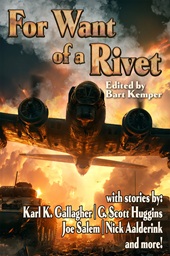
 For Want of a Rivet
Edited by
Bart Kemper
(Raconteur Press, May 2026, 276 pp, Pb, Kindle)
“Wings Over Jutland” by William Meinert
“Ace of Aces” by Karl K. Gallagher
“Radio Waves” by Joe Salem
“The Danzig Ghosts” by Michael Patrick Coady
“The War They Could Not Print” by Ross Hathaway
“Little Groups of Paratroopers” by Bart Kemper
“Callis Caecus” by Nick Aalderink
“Operation Unthinkable” by Samuel A. Mayo
“Cuthbert’s Silence” by D. S. Ligon
“Axis of Alliance” by G. Scott Huggins
“The Last Kamikaze” by Robert Miller
Reviewed by Philip Hutson
Each of the stories in For Want of a Rivet had one fact historically altered to allow a different outcome than the original historical event.
For “Wings Over Jutland” by William Meinert, the manufacturing and deployment of aircraft carriers was moved forward by three years because the English military pressured Winston Churchill for aircraft carriers and aircraft-delivered torpedoes in 1913 instead of later.
The story starts with the Battle of Jutland, with Lieutenant Fredrick Rutland and his spotter looking for German ships. The changes that the addition of the new weapons platform and torpedo delivery method provided resulted in shortening the war.
This story held my attention because it was a subject that I know little about. Not being a military history buff, I had to do some research to guess at what the change was.
In “Ace of Aces” by Karl K. Gallagher, the small historical change was a decision by Congress that no airplanes would be allowed to be purchased or used by the Army or any military branch; the result of this decision was the creation of flying squadrons fighting under a Letter of Marque. The story centers around two flying privateer outfits: Top Hats led by the legendary flyer Eddie Rickenbacker and Rough Fliers led by the four sons of Theodore Roosevelt. The story plays out the changes that were wrought by the need for civilian fighters.
I really enjoyed the descriptions of dogfights and the downing of observation balloons. There was plenty of airplane action packed into this short story.
“Radio Waves” by Joe Salem explores the what-if of Japan developing a high-resolution, long-range radar before WWII. The story opens with the protagonist, a pilot, getting ready to drop torpedoes on the US Navy ships at Midway. In the story, the author describes the presentation of a new focusing antenna. During that event, the antenna operators sweep across a metal flagpole and receive startling results, leading to the creation of a highly effective radar.
This story divided the narrative between the air battles and the military strategy that the new radar afforded.
This was another good story, with enough action and strategy to satisfy a broad audience.
“The Danzig Ghosts” by Michael Patrick Coady tells the alternate history of Germany developing the technology to make use of peroxide in submarine propulsion, allowing the sub to stay submerged indefinitely and travel faster and deeper.
The story starts with the defining event of the presentation of an alloy treatment to allow them to withstand the corrosive effects of peroxide. From there, the story continues with the war in the Atlantic and the result of Germany having a fully submersible, fast submarine.
This story gave me insight into how much difference a submarine can make in naval battles.
I enjoyed the limited sub battle scenes; I just wished there were more. For a Navy enthusiast, this would be a recommended story.
“The War They Could Not Print” by Ross Hathaway is a reimagining of the Battle of the Beams. In this alternate history, the English are less aggressive in countering the beams, allowing the Germans to continue to believe it was still effective.
The story reminded me of “Cryptonomicon” by Neal Stephenson, and the idea of war as control of information. The story does not get very deep into the mechanics of altering the beams but delves more into the results and the information war that went on to support the belief in the infallibility of the beams.
I enjoyed the story, especially the information war that took place.
“Little Groups of Paratroopers” by Bart Kemper takes place around the story of the Triple Nickel (555th Parachute Infantry Battalion). The change in the story was that the Triple Nickel was deployed to Belgium to provide relief to a group of the 82nd Airborne that was surrounded.
During the lead-up to the change, the story gave you a feel for the danger that the Triple Nickel dealt with every day, supporting the Forest Service and the frustration of not being allowed to fight for their country.
This was a good story delving into life as a smoke jumper and later what it was like to jump behind enemy lines.
“Callis Caecus” by Nick Aalderink starts near Cassino in Italy; in this alternate history version, the Allied troops stumble upon a hidden Roman tunnel-road, leading them to an area behind enemy lines.
The story is full of action along the lines one would expect from an account of war from the point of view of infantry. Most of the narrative is of the skirmishes with the Germans that ensue as a result of the tunnel discovery.
The battles are described with enough detail to really put the reader in the middle of a firefight.
“Operation Unthinkable” by Samuel A. Mayo takes place immediately after the German surrender. In this story, the change was that Churchill executed the plan to push Soviet Russia out of Poland and back to the Russian border. The narrative is of a Sherman Firefly tank crew, consisting of Polish and English servicemen, trying to hold a ridge.
The scenes of the crew in the tank were very realistic, even to the point of talking about the smells in the confined space. Again, another story setting that I had no detailed knowledge of; I just knew tanks fired big guns. I really liked learning more about the life of a tank crew.
“Cuthbert’s Silence” by D. S. Ligon is a story of the spy networks in France during WWII. This story stayed true to the anthology’s title; the difference in this one was a rivet in a prosthetic leg. This story’s central character was the real-life British Special Operations Executive (SOE) spy Virginia Hall; the difference was that a person in the employ of the SOE improved Virginia’s prosthetic leg, allowing fuller, silent mobility and removing a memorable limp.
This story touched briefly on a few operations that Virginia executed, but there was not enough of any of them to really get a good feeling of the life of a spy in France.
In “Axis of Alliance” by G. Scott Huggins, Trotsky becomes premier of the Soviet Union and, from there, is able to spread communism across Europe, unlike Stalin. That small change had long-lasting global impacts affecting the course of WWII.
This story took a bit to get going, but the author nailed the ending. The historical changes in the alignments during WWII were interesting.
“The Last Kamikaze” by Robert Miller explored the idea of the US not deploying an atomic bomb during WWII. It is told from the point of view of Japanese airmen and soldiers during the final push of the US forces to take Japan.
The story had plenty of military action of a few different types of combat, but what set it apart was the elucidation of the emperor worship that was common in Japan leading up to and including WWII.
I definitely enjoyed reading a different and not often told story, at least in the US, of the Japanese mindset.
I thoroughly enjoyed this anthology and would highly recommend it. Because the stories cover so many of the armed forces’ domains, it will appeal to anyone with any interest in military fiction, and for the hardcore military history buffs, it will have them thinking about the what-ifs.
Philip Hutson’s ramblings and poor attempts at storytelling can be seen at https://tr8t.com