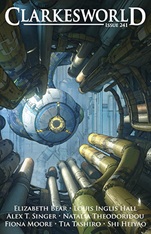
 Clarkesworld #241, October 2026
“A Vintage Kind of Death” by Alex T. Singer
“The Mari Lwyd” by Fiona Moore
“How Does One Person Kill A Mountain?” by Shi Heiyao
“The Job” by Elizabeth Bear
“Five Bottles in Memory of the Winemaker Petronius Finch” by Louis Inglis Hall
“Roams the Planet of Our Grief” by Natalia Theodoridou
“The Rice Paper Bleed” by Tia Tashiro
Reviewed by Philip Hutson
“A Vintage Kind of Death” by Alex T. Singer is a story about future AIs playing tourists by being placed in artificial bodies in a vintage replication of a city. The manufactured bodies provide a complete sensory experience so that the bodyless sentient artificial creatures can experience what it would have been like to be human in a historic city with all the bad and good that it entails.
In the story there is no indication if humans still exist or everyone the tourists encounter are androids or not.
This was a different take on the future of AI and an even more unique twist on the idea of a virtual vacation that was famously explored by Philip K. Dick in “We Can Remember It for You Wholesale.”
“The Mari Lwyd” by Fiona Moore is set in a post-apocalyptic future where society has collapsed and been replaced by a society void of government. The little bit of the world that is described in the story is divided up among a few villages and some nomadic foragers. The villagers make use of a few autonomous mobile robots that had served different militaristic purposes before the collapse of society.
The protagonist, Morag, makes her way in life by finding bits and pieces of tech in the many local mines and other remnants of the long-gone societal infrastructure with the help of her mobile robot, described as a walk-bot. Morag takes that salvaged tech and repairs and repurposes it and then trades it to other villagers.
The story starts with Morag heading to a mine to investigate stories of a ghost.
The story itself was a very unrealistic vision of a post-apocalyptic world where humans have overcome their base desires and autonomous robots can overwrite their base programming.
“How Does One Person Kill A Mountain?” by Shi Heiyao is set in the future in the African country of Malawi. Humans have achieved FTL space travel and have started to explore the universe. In their exploration, they have encountered extraterrestrial life forms, some of which they have brought back to Earth. The alien creature in this story has the unique ability to consume and digest anything, resulting in extremely valuable excrement. The organic matter contained in the feed for the creature becomes a fertilizer, and the metals become ingots that can be plucked from waste.
The protagonist, Bakili, is a “Senior Feeding Specialist,” which just means he is using a crane to get the stacks of containerized food (refuse) to the mouth of the mountain-sized creature.
The story was one of a little-explored concept of the exploitation of an alien life form. The story in general felt like propaganda for industry, no matter what it did to the locals or the environment, which was an interesting contrast to some of the other stories in this issue of Clarkesworld.
“The Job” by Elizabeth Bear is set a couple of centuries in the future when the Earth has been destroyed by unchecked avarice. The oceans have collapsed, and the environment has been so polluted as to be almost unlivable.
The protagonist, Bethony, has taken a job on a distant planet to find mineable caches of rare earth elements and highly sought-after metals. To perform this work, she has been given a new body in the form of a giant whale. Bethony and her coworker Melrose, also whale-like, are tasked with using the body’s sonar to explore the ocean floor on a recently discovered world, Terra Encantada, light-years from Earth. They are supported in their task by a person, Castle, aboard an orbiting ship. If the team finds a mineable amount of material, they all will receive huge life-changing bonuses.
If one can ignore the anti-human preaching, the story is a good story with a decent ending.
“Five Bottles in Memory of the Winemaker Petronius Finch” by Louis Inglis Hall is a horror story of a winemaker, told by the son at a tasting event of five bottles that his father, Petronius Finch, had produced. Each bottle tells the story of the growth of the winemaker in his craft and the family. The first bottle is one of the first ones he had produced, followed by the other four bottles, continuing the story to the end.
Being a wine drinker in a wine region, this was a different take on wine and how it could be produced.
“Roams the Planet of Our Grief” by Natalia Theodoridou is a story of a messenger for the dead. The story is set in a world where a “planet” was hurtling towards Earth but ended up flying by. The rogue planet was home to the dead of Earth who somehow ended up there. The story opens with a messenger, one of many, who had received messages from the dead to be given to the decedents’ loved ones.
Most of the story is taken up by sexual encounters the protagonist has. There are only two actual message deliveries around the hookups. The story would have been better if it spent more time on something other than the protagonist’s baser desires. There was plenty of material to explore, including the reasons that the protagonist determined they were trans or even spending more time on the messages.
“The Rice Paper Bleed” by Tia Tashiro takes place in an elder living facility. The protagonist, Chiyo, is apparently suffering from dementia. The story opens with Chiyo complaining to her granddaughter, Emma, that “It’s not the same room.” Emma then tells her that she is having issues with spatial memory because of her age. The story continues with Chiyo unsuccessfully trying to convince her children and grandchildren that the room has changed.
I thoroughly enjoyed this story.
Warning: spoilers. There were hints of Kurt Vonnegut’s “Slaughterhouse-Five,” but in this case Chiyo is slipping between alternate universes.