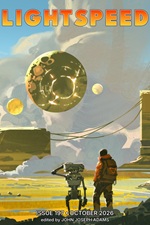
 Lightspeed #197, October 2026
“The Raspberry Manifesto of Professor Warana” by Adam-Troy Castro
“Congratulations on your Magic Swordtm” by John Wiswell
“Guidance” by Martin Cahill
“Until the Cure” by Marissa Lingen
“Master/Slave Couple Seeking Physicist to Feed to a Black Hole” by Arden Powell
“Uncanny Jack” by Susan Palwick
“Ice Like Honey” by Rob Cameron
“All the Shapes We Have Ever Been” by Kehkashan Khalid
Reviewed by Geoff Houghton
The first SF in Lightspeed #197 is “The Raspberry Manifesto of Professor Warana” by Adam-Troy Castro. This tale is set in a distant future and has crossed well over the line defined by Arthur C Clark when he suggested that any sufficiently advanced technology would be indistinguishable from magic. In this future, human bodies are extensively and individually altered at the whim of their owner and even cloned into multi-body collectives with one guiding personality.
The society in which these modified humans live appears to be midway between libertarian and anarchic. One member of this society, described only as “The Mad Scientist” has taken the ability to alter bodies to a new level and has involuntarily changed a noted and controversial artist from a five human-body collective gestalt into a non-motile form never before associated with humanity. The complication caused by the Mad Scientist’s actions is that he has also instilled within the artist the certainty that the new form is the best and most wonderful form that could ever exist. This leaves the ultra-libertarian society with the dilemma of what to do when the victim, apparently sincerely, insists that he does not wish to be restored to his previous form and that this crime is the best thing that ever has, or ever could, happen to him.
The second offering is “Congratulations on your Magic SwordTM” by John Wiswell. Neither the location nor protagonist of this flash fantasy piece are specified, unless you accept the semi-sentient sword and manual combination as the actual protagonist. It initially appears to be a dry and pedantic technical instruction manual for a magical sword, but gradually morphs into a humorously judgemental monologue from the sword/manual combination to the unspecified swordsman. By the end of this piece we still know nothing of the actual circumstances of the swordsman but are entirely clear about the sword’s opinion on his unsuitability as a magical sword owner.
“Guidance” by Martin Cahill is a short SF story set in a near future USA that is easily recognisable except for one new technology that appears to be far too advanced for the rest of its setting. The Guidance named in the title is an AI style personal augmentation able to scan multiple possible futures to predict the actions necessary to avoid future catastrophes.
The protagonist is a middle management level factory safety supervisor whose Guidance warns of a potential disaster in the factory. Predictably, the initial response of senior management is disbelief, followed by pressure on the unfortunate protagonist to blame his Guidance for bad advice rather than admit that his action had saved not only lives but also a vast sum of money in the long run. He is forced into a court case against the Guidance manufacturers, although he knows that it actually saved the day.
An author is free to postulate any technology that they choose, but the reader has the right to expect it to be consistent within the story. Therefore, the author needs to explain why only the relatively cheap, mid-market Guidance of this particular manager saw the future disaster looming whilst the, presumably similar, Guidance of the man who made the error and his relief did not. Such a powerful device would also entirely change the world in which it existed by leading people to regularly choose the safest of all the alternate timelines visible to their Guidance. That could have the same effect as Isaac Asimov proposed more than half a century ago in The End of Eternity, namely the gradual creation of a very low-probability world where both dangers and serendipitous opportunities were minimised.
The second fantasy offering is “Until the Cure” by Marissa Lingen. This emotionally moving story is set in a world where magic is substituted for technology, but it is also a society where a terrible degenerative disease is raging beyond the control of either science or magic. The first person protagonist is an able and likeable female magician whose mother is an unfortunate victim of that disease. Our protagonist has constructed a magical golem nurse to free her from the task of caring for her mother, not because she does not wish to do so, but in order that she could focus on trying to find some effective treatment. Now she has exhausted herself in seeking a magical cure for this plague without any apparent success. During the course of this story, she realises that her success with the nurse-golem could be a minor but genuine victory over the plague if she could replicate that accomplishment by constructing similar golems for other, equally unfortunate families.
It was a pleasure to read a story in which there are no evil characters. There is no Dark Lord sending forth the plague, nor a venal Town Mayor attempting to benefit from it. Our protagonist is a caring daughter doing her civic duty against a pitiless disease without seeking fame or reward. We see only the best of human nature, exhausted but still standing and still trying, against the worst that the uncaring universe can throw.
“Master/Slave Couple Seeking Physicist to Feed to a Black Hole” by Arden Powell is a flash-length SF piece set on a digital dating site in the near-future western world. The title may contain a hint of raciness and even sadism, but that is not the reality. The slave in the story is neither human nor a bipedal alien emulating a human and the Master is even more outlandish. To say more would be a genuine spoiler.
“Uncanny Jack” by Susan Palwick is set in current day North America. It is labelled as a fantasy but could equally well be considered as a mainstream story about a delusional protagonist. The first person narrator is convinced that her bright, caring husband has been replaced by a changeling. The snippets of unequivocal evidence from external observers suggest that the tragic and real situation is that the husband has gradually developed some form of dementia.
Our resourceful protagonist develops and executes a plan to rescue her real husband from the uncanny folk who have performed this substitution.
The reader is left uncertain about how much of this rescue journey into the fey world occurs in our protagonist’s head, but the final outcome is a definitive resolution of her tragedy.
The final SF story is a novelette length tale: “Ice like Honey” by Rob Cameron. It is written in nine consecutive chapters, set in a dystopian, near-future, Washington DC during the slow recovery of the planet from global ecological catastrophe. The central character is a nuanced young black woman whose complex character, physical combat skills and fragile clinical state combine to create an acutely memorable protagonist.
The author has chosen to emphasise the racial divisions and separate lives of black and white inhabitants of Washington DC in this multifaceted cyber-noir story. It rattles along at a breakneck pace, throwing new characters into the reader’s path at a dizzying speed, and most of the principal characters are black or latino. The reader is advised to keep notes of who is with which faction, and will still find that such notes are best made in pencil, since not all is as it seems in this byzantine drama.
It opens with a gruesome murder that turns out to be a violent interrogation gone wrong, but there are no entirely innocent victims in this story. Our protagonist has worked as an enforcer for a major black Washington gang and the murder victim is an agent of that cartel. The Washington Police Department is riddled with thuggish bullies, the people’s elected representatives are corrupt and avaricious, and big business is entirely venal. Even conventional news outlets are easily bought or manipulated by the multiple forces that share control of the city.
The dystopian future so vividly painted by this author may already be half-way to reality, but it is a deeply uncomfortable world to consider. This reviewer prefers to bury his head in a shiny-bright, squeaky-clean Star-Trek style future.
The final story is “All the Shapes We Have Ever Been” by Kehkashan Khalid. It is set in a fantasy world of bold Princes, fierce guardian dragons and helpless captive Princesses. The protagonist is the latest of those Princesses, but she entirely fails to live out her allotted role. She befriends the dragon, learns his story and all about his world. Finally, she leaves the tower under her own steam, without waiting passively for an appropriate Prince to rescue her, and seeks out the dragon’s home dimension. What happens to her during her time there is not explained, but she returns as a changed and greatly empowered person who easily slays the very next questing Prince, rescues the dragon and rides him off into the sunset in this feminist retelling of a classical fairy story.
Geoff Houghton lives in a leafy village in rural England. He is a retired Healthcare Professional with a love of SF and a jackdaw-like appetite for gibbets of medical, scientific and historical knowledge.