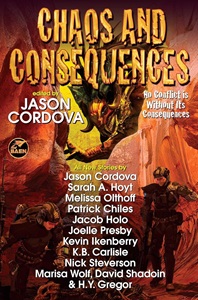
Edited by
Jason Cordova
(Baen, November 2026, pb)
“More Than Survival” by Melissa Olthoff
“End Run” by Sarah A. Hoyt
“Embracing the Suck” by Patrick Chiles
“Alone” by Kevin Ikenberry
“An Omnishambles Assessment” by Marisa Wolf, David Shadoin, & H.Y. Gregor
“Murderplex” by Jacob Holo
“When the Third Moon Rises” by K.B. Carlisle
“They Should Call Us Gods” by Joelle Presby
“Bohemalowdown” by Nick Steverson
“Hunter of Demons” by Jason Cordova
Reviewed by Malory
This is the second of Baen’s shared-monster anthologies, following Dancing with Destruction, and the conceit is a fun one. In the introduction, the editor explains that Kurt Miller’d already painted the alien from the first cover a second time, “on a new world, with new soldiers being stalked and hunted, or even assisting it,” and the writers then dropped it into their own universes. In one story, it’s “a genetic monstrosity that should never have been created,” in another there are “dragons they’d bioengineered to guard the compound,” and in a third the Marines have orders to bring it back alive. It must’ve been the busiest monster in the multiverse!
“More Than Survival” by Melissa Olthoff opens the book with Captain Jace Benning marching a mixed bag of survivors from across the Sonoran Desert after the bombs have fallen and the chain of command has gone all quiet. Soldiers cut off from home and walking out through hostile ground is one of the oldest of military stories, and Olthoff well understands that this only works if the squad’s worth spending time with. It thus goes without saying that the banter carries a lot of the story’s load! A further strong point is that the thing hunting them is heard for a long time before it’s seen, which creates a powerfully involving atmosphere. Likewise, Saber, the cheerful scout who keeps turning up in their path and chatting to a partner nobody else can hear, is a delight. If I’m going to be picky, Jace’s grief is signalled a few too many times, but this is a confident opener.
“End Run” by Sarah A. Hoyt uses the Double Indemnity frame where a wounded man tells the whole story from the end, and Hoyt also tips her hat to Casablanca with the first line of the flashback: “Of all the dead-end bars in the universe, did they have to come into mine?” Two armoured nobles walk into his bar (which sounds like the start of a joke) carrying a letter from the woman he never got over and the promise of a royal pardon. They need a pilot and a fighter for a raid on a desert world where children are being bred and sold. There are some truly cracking lines here, my favourite being “You could have used his nose for a ruler to set the universe straight,” but the narrator’s world-weary cynicism has a decent heart under it. My one grumble is the dinner, which goes on for a couple of pages about who all these people are, while, on the other hand, the job the narrator was actually hired for gets one line, “I got up early and worked feverishly through the day.” I still had a lot of fun with this all, though.
Patrick Chiles gives us “Embracing the Suck,” narrated by Melanie Mooney, a civilian biologist and former medic for the Galactic Union who’s been pressed into service as a combat medic. The bad guys here are the Skinnies, who are tall, aggressive cousins of the Reticulan Grays, and, of course, the Marines want some alive. The best bit is the insertion, where the Thuban command ship does what Mooney calls “a trash dump” so the drop can come down hidden in a fake meteor shower. There’s a long stretch of First Contact history after the opening firefight which slowed me down a bit, but once they’re all in the cave everything picks right up. I was completely gripped.
Powered armour has been a military SF staple since Starship Troopers, and “Alone” by Kevin Ikenberry, subtitled “A story of the Buzzer War,” certainly knows its armour inside out. A team of Marines in ATLAS suits drops onto Tau Ceti e, a super-Earth with Mach 2 winds and more than double Earth’s gravity, to look into radar returns at the foot of a mesa that might be something artificial. It’s all “a little breezy out there today” and before they’ve even landed Balyeat has patched everyone’s suits with “the latest and greatest combat and self-defense package with enhanced snooper and sensor updates.” The viewpoint is mostly Carson Balyeat, a Specialist Six suit technician attached to the Marines, which makes for plenty of friendly interservice needling. A piece of suit tech introduced early is paid off later in a way I found very satisfying, and the rockfalls are superbly staged. The last act is the best-judged in the book.
The title of “An Omnishambles Assessment” by Marisa Wolf, David Shadoin, and H.Y. Gregor borrows Malcolm Tucker’s line from The Thick of It and certainly lives up to any expectations you may have there. The narration itself alternates between Randy, a foul-mouthed scout on a colony that was promised a dead planet and got a jungle full of carnivorous plants instead, and Krishtakta, a fussy alien scientist who’s come to check on a planet she seeded with her own designed species and can’t work out why her apex predators keep turning up dead. The reader, who can see both halves of what’s going on, is obviously a step ahead of either of them, and that dramatic irony is where all the comedy comes into play. I think that Randy’s sections are the funnier ones, and the colonial council that brushes off the landing party’s report is nicely skewered. Nevertheless, Krishtakta is wittier than she first looks, with an enjoyable vanity and rivals waiting to claw into any mistake, though I did find her second section to read a bit like a lab notebook.
I loved “Murderplex” by Jacob Holo! It’s a Sol Blazers story, and the most purely entertaining thing here. Captain Nathaniel Kade juggles a pair of pistols and asks what’s the worst that could happen, to which his cat-girl pilot replies “Would you like my answer alphabetically or categorically?” The crew are hired to recover a relic from the orbit of a planet that vanished long ago between Saturn and Neptune. As a character explains, its name translates as “Your Butthole.” You get it? What they find, though, is a habitat that looks oddly small from outside. And there are two docked, silent ships and a pile of bodies within. Then, a few pages later, an announcer is bellowing “STALKER UNLEASHED!!” Anyone who fed coins into Smash TV will recognise what’s going on here, and Holo keeps the jokes and the jeopardy running at exactly the right speed. I very much have a soft spot for any story in which “the tube was long, completely dark, and filled with a combination of water and swearing.” It’s comic space opera more than military SF, but I laughed all the way through.
“When the Third Moon Rises” by K.B. Carlisle is set on Cihera, a one-continent world with three moons, meaning it’s a world where River Canyon becomes Canyon River every time the third moon comes up. Gus Painter, a civilian fixer, is hired by the military to find their missing trackers, which he sums up for his grenade-happy sidekick Brandon as “tracking the trackers.” Hapi, the third moon, is already on its way across the sky, so they’re racing the water the whole time. The first soldiers they find are in a bad way (one is “nothing but bone from the chest down”), and for a long while the creature is only “the heavy stomps of whatever creature was lurking just beyond their sight.” I lost track of who was where in a couple of the fights, but I certainly enjoyed it.
“They Should Call Us Gods” by Joelle Presby is superb. Julia Kiddo is a stationer who’s never set foot on a planet, but she still volunteers for a ground mission as a gunner alongside two veterans. Then a panicked “warning shot” goes straight into the mouth of a charging gator-rex, and her reward for this bit of accidental heroism is to be recommended for permanent ground duty. Kiddo’s enchanted by the planet on that first drop, and by the second she’s arrived at “I hate planets,” which is some quality character development. The sections are headed Mission 1, Mission 2, Mission 6 and so on, so whole missions go by off the page. The last heading is “Mission 9…Hopefully Last Mission.” It’s my favourite story in the book.
“Bohemalowdown” by Nick Steverson brings back characters from the first anthology, though it stands up fine on its own. Private First Class Vincent Moretti, freshly demoted after a shore leave he fondly remembers, and Gunnery Sergeant Warwick are minding a comms relay on a desert moon while their unit hunts a lone male Bohemalo. This is a big alien that goes feral without a female around to keep its mind clear, and it’s wanted alive. That’s a good bit of xenobiology here, turning the monster into something to be managed, which is a lot more interesting than it just being one more thing to shoot. Moretti and Gunny are a proper double act and there’s a thread about a knife and a note signed “G.” that’s quietly touching. The barrack-room humour won’t suit everyone, but this is good fun.
Finally, there’s the editor’s own story, “Hunter of Demons” by Jason Cordova. It’s a Quintus Fox adventure and he introduces himself as “the best bounty hunter in the universe.” The rest of the story takes enormous pleasure in puncturing that image. He’s also a deputised game warden, called to a red desert world where someone is poaching endangered quantum wolves for their fangs. It’s more space western than military SF, but it’s funny indeed, especially when Fox, tied up and treated to a villain’s philosophy of the hunt, derails the speech by correcting his usage. It’s a warm-hearted way to close the book.
The editor ends his introduction with “My only complaint was that we ran out of room.” I enjoyed this one a lot, Presby and Holo especially, and I’d happily read a third.
The blurb at the front of the book promises stories “ranging from the absurd to the deadly,” and that’s pretty much what’s in here, with Holo and the Omnishambles lot at the absurd end and Olthoff and Carlisle down at the deadly one.
There’s also a lot of sand…