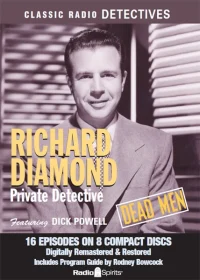
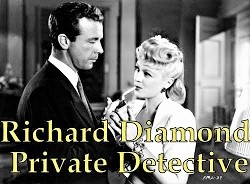
 Richard Diamond, Private Detective (1949-52) aired “The Man Who Hated Women” aka “The Butcher Killer” on April 12, 1950. This is the eighth Richard Diamond episode we’ve presented, the first being from early November of 2019 and the last from November of 2023, three years ago. Due to the popularity of the earlier shows I thought it was time to offer Diamond fans with another. Therefore–-for newcomers to the show and those wishing to refresh their memories–-I reprise in slightly abbreviated form our earlier historical sketch of the program and its recurring characters.
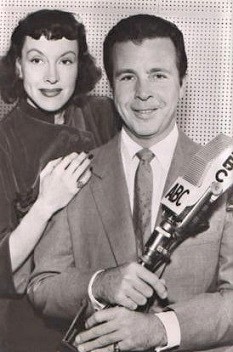
The show originally aired over NBC stations, then ABC, and then finally in 1953 by CBS, but all of the CBS shows were repeats from the 1950-51 season, thus some old time radio sites list the show’s run as going into 1953. Richard Diamond (starring film icon Dick Powell, 1904-1963) was an ex-cop turned private detective who maintained good relations with his ex-boss and police lieutenant Walter Levinson (played by Ed Begley [1901-1970], probably most well remembered as juror #10 in the classic 1957 film Twelve Angry Men, and father to actor Ed Begley, Jr.). Diamond’s girlfriend, Helen Asher, was played by Virginia Gregg (1916-1986, photo below with Powell), who went on to have many film and television roles (including the Twilight Zone episode “The Masks” which aired March 20, 1964). The character of Richard Diamond–-and the radio program itself–-was the brainchild of Blake Edwards (1922-2010), perhaps best known for writing and directing the Pink Panther movies, as well as directing other fine films such as Operation Petticoat (1959), Breakfast at Tiffany’s (1961), and Days of Wine and Roses (1962). Blake’s private detective Richard Diamond didn’t exactly fit the standard mold people were used to, as typified in the novels of Dashiell Hammett and Raymond Chandler. While he  could wisecrack with the best of them, he was also suave and sophisticated and tough as nails, living the high life in New York City when not found visiting the swank penthouse apartment of his girlfriend, Helen Asher. Being a well-seasoned song and dance man due to his many early movies where he inevitably ended up singing, Dick Powell was the perfect choice to play Richard Diamond, especially after his smashing success in 1944’s Murder, My Sweet. Audiences loved Powell as Diamond, so much so that the show’s popularity warranted its own television counterpart. It starred David Janssen (1931-1980) and ran from 1957-1960. Janssen, of course, is best remembered for his iconic role as Dr. Richard Kimble in the classic TV series The Fugitive (1963-67).
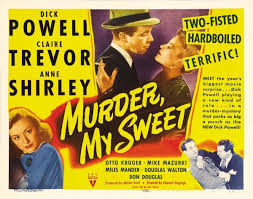
 Dick Powell’s breakout film (briefly mentioned above) was 1944’s noir classic Murder, My Sweet. Based on Raymond Chandler’s detective character Philip Marlowe from his 1940 novel Farewell, My Lovely, the film was released with the book’s title but audience reaction was tepid at best, the feeling being that the title wasn’t dark enough and audiences assumed it was just another of Powell’s many light romances he had been making since the 1930s (30+ such roles from 1932-1939), in which he played handsome young men who wooed women with his boyish good looks, musical ability, and crooning voice. Getting older, and desirous of more mature roles that fit his middle aged demeanor, he convinced the powers that be to give him the role of Marlowe from Chandler’s novel. It was quite a gamble but Powell pulled it off admirably and the film is now recognized as a noir classic. When the film was released in late December of 1944 with the novel’s title and proved unsuccessful at the box office, it was quickly retitled Murder, My Sweet and re-released in February of 1945 in St. Louis with much better results. The box office and critical acclaim following the film led to several other noir films of note with Powell in the lead: Johnny O’Clock (1947, in which he played a detective), To the Ends of the Earth (1948, crime noir), and Pitfall (also 1948, film noir where he starred as a bored insurance agent who falls in love with the wrong woman).
Powell was also active in television as actor, director, and producer. Arguably his best known TV endeavor was Dick Powell’s Zane Grey Theater or as it came to be known, simply Zane Grey Theatre (1956-1961). It was a western anthology series based on the works of Zane Grey, but as time went on new material was added to keep the stories fresh. It guest-starred many of the most well known or beloved and/or major TV/movie stars of the day, including but not limited to: Anne Bancroft, Robert Blake, Ernest Borgnine, Lloyd Bridges, Claudette Colbert, Hedy Lamarr, Julie London, Ginger Rogers, James Garner, Dennis Hopper, Burl Ives, Michael Landon, Edward G. Robinson, Jack Lemmon, David Niven, John Dehner, Burt Reynolds, Lon Chaney, Jr., Barbara Stanwyck, and many more. Much beloved in Hollywood and throughout the country by his legion of fans, Dick Powell died on February 3, 1963. His widow, well known actress June Allyson, gave his cause of death as lung cancer due to his chain smoking. Powell has a star on the Hollywood Walk of Fame.
This episode opens with two men on the road one evening spotting what looks like a dead dog on the side of the road. When one of them believes what they’ve driven past is too large for a dog, they stop to take a look. What they discover makes one of them admit he is about to be sick. The next scene shifts to the police giving Diamond a call and reading him in on what is now a series of grisly murders, and asking for his expert help, as public officials are calling for his police lieutenant friend’s head if the gruesome murders aren’t solved immediately. To cut to the chase, if you will allow the cheap pun, Diamond learns that a psychopath is using any sharp implement he has to hand to stalk, seduce, and slice up women. Axe, hatchet, knife, it doesn’t matter. It’s a fast-paced, damn the torpedoes, full speed ahead chase for Diamond, as at one point he makes a bold move he would not normally make in order to get “The Man Who Hated Women,” who has now devolved into “The Butcher Killer” off the street before more women are emotionally seduced and mercilessly executed.
[Left: Murder My Sweet poster — Right: Virginia Gregg & Dick Powell]
(The linked CD at top of page includes this episode and 15 others, all remastered and restored.)
Play Time: 29:30
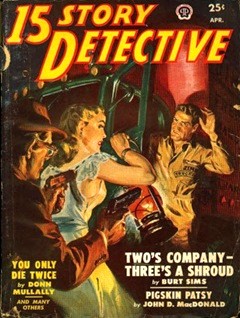
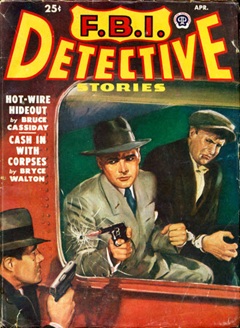
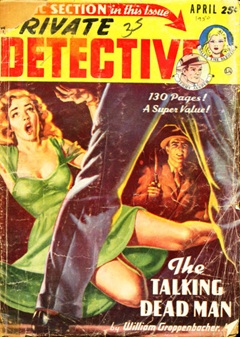
{Airing late on a Wednesday night in early April of 1950, this episode of Richard Diamond, Private Detective made the neighborhood gang uneasy, wondering how any man could be so cruel toward women. That uneasy feeling was kept in check the next afternoon after school as they made their way to the nearby newsstand, remembering that there were also Good Guys like Richard Diamond in the world out to stop the Bad Guys. Wanting to feel that they were some of the Good Guys—even vicariously—by reading about others on the right side of the law, they made their reading choices accordingly. 15 Story Detective (1949-51), regarded mostly as an unremarkable magazine in its short 16-issue lifespan, was best remembered for its stories by John D. MacDonald, and even one by SF author Cyril Kornbluth. It was a bimonthly in 1950. F.B.I. Detective (1949-51) while still kept afloat with its dwindling audience, was soon forced to cease publication as peak interest in the crime-fighting exploits of federal agents had passed, its heyday occurring in the 1930s-40s in print, film, and radio. F.B.I. Detective was a bimonthly in 1950. Private Detective (1937-50) enjoyed a much more respectable run, with a somewhat toned down version of the “Spicy” detective and mystery pulps introduced for a short while in the early 1930s. Its covers were not as sexually suggestive as were those of many of the Spicy pulps, and its evil doers weren’t as psychologically damaged as some of those in the Spicy magazines. Private Detective was a monthly in its final year but managed only 9 of its 12 issues.}
[Left: 15 Story Detective, 4/50 – Center: FBI Detective, 4/50 – Right: Private Detective, 4/50]
To view the entire list of weekly Old Time Radio episodes at Tangent Online, click here.