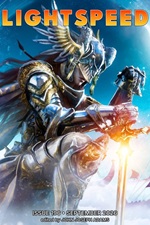
 Lightspeed #196, September 2026
“A Guide on How to Repay Your Vow to the Deity of Many Faces” by Oyedotun Damilola Muees
“Dreamweavers” by Alexander Weinstein
“The Chrysalis of Moth One” by V.M. Ayala
“Long Goodbyes” by Anya Ow
“Alterverse” by Sanjana Raj
“The Dragon, the Scarab, the Wolf, the Dragon” by Rhiannon Rasmussen
“Maskwork Saltman Giftbox” by Rich Larson
“Jempo” by Thomas Ha
Reviewed by Mike Bickerdike
“A Guide on How to Repay Your Vow to the Deity of Many Faces” by Oyedotun Damilola Muees is fantasy flash fiction. The piece comprised numbered instructions for protecting the life of a man’s daughter. Although it is set out as a series of instructions, it veers into descriptive prose occasionally which makes for slightly disjointed styling. It’s okay, but offers little novelty in its ideas, and lacks a surprising outcome.
“Dreamweavers” by Alexander Weinstein is a dystopian SF short story. It starts like many stories, using a somewhat distant, past tense style, presenting exposition that will presumably frame the story to come. However, this arms-length, past tense prose is maintained for most of the tale; the result is a story that lacks any immediacy or tension. Reading more like a list of dreadful consequences from climate change and unreserved tech advances than an actual story, it falls a little flat. Moreover, for dystopian literature to have the punch it seeks, it also needs to convince in its details. Unfortunately, this story presents several glaring errors—for example, the sea level is nearly covering Coney Island Ferris wheel (which is 150 feet tall), so Manhattan should be almost completely underwater, though we are told water is only lapping its edges.
“The Chrysalis of Moth One” by V.M. Ayala is a piece of SF flash fiction that is hard to love. Two queer soldiers (or slaves?) are sent to fight a mechanical moth, somewhere, for reasons unexplained. The tale is replete with expletives for the sake of it and full of righteous anger, but offers little in the way of ideas or novelty.
“Long Goodbyes” by Anya Ow is a fantasy short story. In a world of perpetual war against a demon hoard, a female ‘sword saint’ returns to her father’s land with her steed—a mythical creature called a Zheng. At home, she is faced with an arranged marriage she wishes to avoid. The story focuses on the relationship between the swordswoman and her bonded Zheng. Although some of the fantasy ideas are reasonably imaginative and allow for decent imagery, there is not much here that feels new or inventive.
“Alterverse” by Sanjana Raj is an SF short story; yet another set in a dystopian world post-climate change, though this one adds the fall-out of expanded virtual reality and unfettered technology to the mix. All this makes for quite a sombre read. While many (including this reviewer) are fearful and worried about the current direction of travel regarding climate change and virtual reality, the steady stream of SF on the subject that offers no solution or hope is slightly wearing. The set up of virtual reality tourism, guided by headset (the digital world is the titular ‘Alterverse’), is reasonably well-rendered. However, occasional lapses in the writing unsettle the rhythm of the prose. As an example, the protagonist’s mother “lays horizontally across her bed” at one point; she didn’t just “lay on her bed”? Was lying vertically an option?
“The Dragon, the Scarab, the Wolf, the Dragon” by Rhiannon Rasmussen is fantasy flash fiction. A low-born man undertakes a transformation to become a wolf-lord, but all is not as it seems. Like most flash fiction, it is hard to avoid the conclusion that, while somewhat successful, it might have been better if it were longer. There’s a reasonably interesting story here, but it needs fleshing out.
“Maskwork Saltman Giftbox” by Rich Larson is SF flash fiction, and a well-crafted story. It stands head and shoulders above most of the other work in this issue. The idea is novel—mask wearers imitate the rich and famous so society’s elite can be seen to be everywhere that’s socially important. The imagery, such as the protagonist’s memory of ‘the Saltman’ from his youth, is bright and memorable. The story also delivers, with a delicious twist at the end. Larson manages to pack more depth, character and plot into his short piece of flash fiction than most modern authors manage in much longer tales. Recommended—the best story in this issue of the magazine.
“Jempo” by Thomas Ha is described as a fantasy short story, though it certainly has SF elements. Competitive one-on-one battles are fought out between ‘maquinas’—part robot, part cadaver—remote-controlled by their owners from the ringside. Ruth has entered a competition where she comes up against a competitor, Aga, who employs old, forgotten strategies with her own ‘maquina’, Jempo. Aga’s approach to the fights gives Ruth pause to consider what means more, winning or how you take part. It’s really quite good, and is also recommended reading.
More of Mike Bickerdike’s reviews and thoughts on science-fiction can be found at https://starfarersf.nicepage.io/