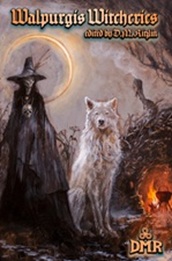
 Walpurgis Witcheries
Edited by
D.M. Ritzlin
(DMR Books, April 2026, 198 pp. pb)
“No Mercy for Witches” by Ethan Sabatella
“The Black Hound” by Owen G. Tabard
“Hecate’s Offerings” by Keith J. Taylor
“The Vigil of Sister Liudgard” by Sam Belleneuve
“The Wandering One and the Witchdance” by M. Stern
“Cold Night on the Field” by Harry Piper
“Balefires Upon the Brocken” by J.R. Young
“The Sorcerers and Mysteries of Mercury-Wotan” by Matthew Pungitore
“When the Great Wyrm Wakes” by Deborah Tapper
Reviewed by Malory
In this anthology, DMR Books brings us nine tales of sword and sorcery, with every one set on, or somewhere in the shadow of, the Brocken in the Harz mountains on Walpurgis Night. That’s a tighter brief than most themed anthologies, so I was pleasantly surprised by how much variety the writers manage to wring out of it.
There’s no introduction (the book goes straight from the contents page into the first story), which I think is a mistake, as a few pages on the Brocken and its sabbath would have helped anyone coming to all this cold.
“No Mercy for Witches” by Ethan Sabatella has Albrecht von Eschenbach, a knight who once served briefly alongside the man he’s hunting, up a mountain. His erstwhile colleague’s murdered an unbaptised girl and means to spend her blood in a spring rite. I found this interesting because, as a questor, Albrecht isn’t trying to save a life (he’s already too late for that) but is rather seeking to settle where her soul ends up. The mountain climb’s built as a run of temptations, with the pick of them a feast of gnomes whose entire authority seems to live in their chief’s hat. This was an effective moment, unlike the nymphs in the pool who got a sword-polishing double entendre that felt a little out of place. Sabatella’s prose is heavily ornamented pastiche (“war-graith,” “neesings,” “prophane”) and I must say that I found it a bit much in places, not helped by a few garbled sentences that have made it into print (“the feather in his cap mushroom-like hat”). The bit at the summit, though, is some good, gory pulp.
“The Black Hound” by Owen G. Tabard is narrated by a cursed sword, and is a lot of fun. The blade’s a snob about the blood it drinks, is forever scheming, and is constantly undercutting its own narration (“Amateurish, really”). It was, long ago, given up by a Viking who turned monk, and is now in the hands of a one-eyed witch-hunter, who wastes no time in beheading a maid everyone knows to be innocent, and then drags a small party up the Brocken after a runaway noblewoman. “One must never let a minor detail like innocence stand in the way of a good execution” is a line that sticks out! The abbey politics in the middle do sag a little, the fat and cowardly Brother Prior is a stock figure, and the witch-hunter’s backstory arrives in one undigested block. But at about 5,600 words, it clips along nicely. Enjoyable.
“Hecate’s Offerings” by Keith J. Taylor follows Sir Thomas Holand, an English knight on his way home from fighting with the Teutonic Order, who’s detained in Magdeburg and then press-ganged into the service of a Prince-Archbishop with a grim obsession. Taylor’s clearly the veteran of the book, because this is a dense tale with the texture of a real place: a half-built cathedral, a city council that’s already beaten one archbishop to death, rival lords, and a sword said to be Charlemagne’s. Holand’s a proper rogue who means to rob his employer and slip away from the start which is a lot of fun and the supernatural business is cleverly worked out, too, turning on a cleverly procedural bit of witch-lore. My reservation with it all is the closing envoi, which summarises years of subsequent events after a very strong climax. I felt it rather lets the air out of it all.
“The Vigil of Sister Liudgard” by Sam Belleneuve is the story I’ll remember. Every year on St. Walburga’s Eve, a nun of Marienthal Abbey must pass into an antechamber of Hell and hold off its devils until dawn. Liudgard has spent ten years training as the designated second for this and has never expected to go. Then, the day before, the chosen Champion prays for courage and fails to find any and, well, guess who’s up next! The fight writing is well done (half-sword grips, the lugs on a winged spear, the flat of a blade turned to limit the damage) without ever becoming too knowing, and the trials Liudgard faces escalate properly, with the second, a lake of liquid metal strewn with the weapons of earlier Champions, making greed rather than fear the thing that nearly finishes her. The temptation waiting at the end of the road is a genuinely unsettling one, and the story leaves its most troubling question unanswered. This is superb.
“The Wandering One and the Witchdance” by M. Stern introduces Vodoberex, a wanderer from “a very old” tribe who announces that he shall die by no blade. The body horror here’s the most inventive stuff in the anthology, from fifty soldiers laid out with their heads and limbs swapped for those of their horses to a fiend riding under the hero’s clothes with a sac on its head slowly filling. Plus the story takes a swerve I didn’t see coming and moves into something rather lovely. Against that, though, I felt the archaic inversions are laid on a bit thick (“Hear you that sound?”, “Whyfor?”) with more than a few tipping over into awkwardness. It was also irritating that the text can’t decide between Werningrode and Wernigerode.
“Cold Night on the Field” by Harry Piper has no witches in it at all and, by this point, I quite enjoyed the variety. On Walpurgis Night, Otmar, a kind, if slow, young man goes out with the village’s local legend, Hagen, to strip the dead from a skirmish in the woods. What makes this so good is its moral architecture. Hagen’s set up carefully as a hero and Piper then takes him apart. When the Little Folk do arrive, they’re babyish, giggling and cruel, and far more frightening than anything demonic elsewhere in the book. The prose is the least elaborate in the anthology, which I think is a good thing. The ending is very bleak but is absolutely earned.
“Balefires Upon the Brocken” by J.R. Young sends Nathaniel Bowen, Grand Inquisitor of the Elder Church, up the mountain after an ancient sorcerer who means to use a missing seven-year-old boy in a Walpurgis rite. There’s a cruelness at the heart of this and a throwaway line near the end is the nastiest in the book. The trouble is that the prose overreaches almost continuously (“the peaks of the Harz gnawed at the pale April moon, the jagged crowns tearing the night like black fangs”) and piles up epithets so relentlessly that the bad guy is the Scourge of Sarnath, the Sorcerer of Sarnath, the Mage of the Black Lake and the Magus, sometimes within a page, while Bowen is far more often the Right Reverend or the Grand Inquisitor than he is just Bowen. Invented names like Sarnath and the stone city of Ib also sit rather oddly beside Salem and the early Church Fathers, and an unexpected “spacetime” jolted me out of any suspension of disbelief. A miss.
“The Sorcerers and Mysteries of Mercury-Wotan” by Matthew Pungitore is the most imaginative thing in the book. It opens with a superb vignette in an isolated keep, in which a flayed huntsman returns wrapped in bloody linen to deliver a warning, and after that the dark images just keep on coming: a witch chewing off her own breasts, two jesters climbing out of a cauldron, a cockatrice undone by a baron’s mirror. At a little over 4,000 words, though, it’s trying to carry far too much, meaning it summarises where it ought to dramatise. Worse, the contest the quest’s been building towards happens entirely off the page, and a riddle about how to enter the temple is posed and then… dropped. The prose is also a wall of inversions and rare words (borborygmus, cerement, beteem, behight) which I found pretty hard going.
Finally, “When the Great Wyrm Wakes” by Deborah Tapper is the most purely enjoyable story in the book and a proper old-school closer. Halvdan Magnusson is a sorcerer and swordsman who is travelling south with Hjordis, who he knows perfectly well is a Jotunn hiding behind a human glamour. That deception fuels some cracking dialogue, and the opening, in which Hjordis cuts men down while Halvdan rummages for some dried fish, sets the tone well. Likewise, I liked that the magic used has a real cost and that the villain is given the strongest grievance of anyone in the book. My only reservation is that the tavern brawl goes on much too long, with the gore becoming repetitive.
It’s an uneven anthology, but Belleneuve, Piper and Tabard are all well worth the price of admission.