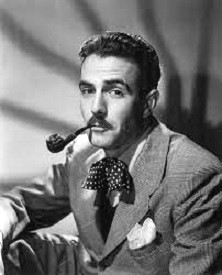
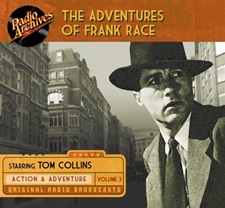
 “Before the war, Frank Race worked as an attorney,
but he traded his law books for the cloak-and-dagger of the OSS.
When the war was over, his former life was over, too . . .
adventure had become his business!”
The Adventures of Frank Race (1949-50) aired “The Adventure of the Pharaoh’s Staff” on January 1, 1950 as the 36th of its 43 episodes. Original air dates for this program are impossible to pin down with 100% accuracy due to the fact that it was not sold to one of the four major national radio networks who would air the shows at a set day and time nationwide, but was syndicated to individual stations across the country who would broadcast episodes at whatever dates suited their local programming. This is the sixth episode featuring Frank Race’s adventures we have run, the first coming on December 10, 2022, with the fifth coming almost a year ago in November of 2025. As such, a recap of the introductory background material provided in that initial episode is below, for newcomers to the show or for those needing to refresh their memories.
The italicized opening at the top of this page is the host’s introduction to each episode. The premise of a private investigator with a government background such as the O.S.S. (Office of Strategic Services, forerunner to our C.I. A.) was not new. Radio had a number of programs prior to Frank Race when espionage was still in the minds of the public following World War II, among them Secret Agent K-7 (1939), The Man Called X (1944), Dangerous Assignment (debuting in 1949), and also debuting in 1949 was Richard Diamond, Private Detective who had a background which included the O.S.S.. The Adventures of Frank Race has been characterized as a combination of Johnny Dollar and James Bond. Johnny Dollar in that Race also investigates (as his cover) for an insurance firm, and James Bond due to the women, intelligent, beautiful and honest (well some of them)—as well as some not so trustworthy, with whom he has encounters. While Race obviously has “cases” due to his work for the insurance company, they are designed more as world-traveling adventures, thus the title of the show.
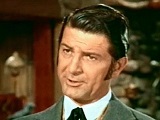 Tom Collins (1913-1973, photo top right) starred as Frank Race for the show’s first 22 episodes. Collins was well known to radio fans as the voice of Chandu in the 1948 run of Chandu the Magician. Beginning with episode 23, Collins would pass the torch to versatile and talented radio actor Paul Dubov (1918-1979, photo at right), and nary a beat was missed. From 1938-1977 Dubov appeared in many film and/or TV shows, a few among them being Day the World Ended (1955), The She Creature (1956), Voodoo Woman (1957), and The Underwater City (1962) for film, and Wanted, Dead or Alive (1960) and Bat Masterson (1961) for TV. Though the title role was split evenly between Collins and
 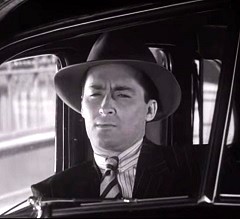 Dubov during the show’s run, Race’s sometimes valet/cab driver/associate and “sidekick” if you will, was Marc Donovan, played perfectly throughout all 43 episodes by Tony Barrett (1916-1974, photo at left as the character Melody Fiske, a piano playing thug in the 1947 film Dick Tracy Meets Gruesome, featuring Boris Karloff), another of radio and TV’s most versatile actors, writers, and even producers. Two of his several TV credits include being one of the writers for the popular detective program Peter Gunn (1958) and one of the primary developers of The Mod Squad (1968). A few of the supporting actors appearing in episodes during the show’s run were many of radio’s finest, including Gerald Mohr, Frank Lovejoy, Lurene Tuttle, Virginia Gregg, and Parley Bear.
This episode finds Race sent to Egypt by his insurance company in New York, via Lisbon and London, to Cairo and its famous museum of antiquity. Recently unearthed and thousands of years old is an artifact of great wealth known as the Pharaoh’s Staff. It is to be loaned to a museum in London, but because of the always possible threat to this one-of-a-kind find and its cultural importance, not to mention financial worth (estimated to be a million dollars), it must be securely guarded from any kind of harm. Arriving in Cairo and looking forward to meeting the museum’s curator to facilitate the transfer of the staff, Race first encounters a beautiful (and quite alluring) young woman, who of course turns out to be the curator’s daughter. Her interest in the staff and concerns surrounding its journey to London soon blossom into a full blown adventure of high intrigue, with the addition of other interested parties who may or may not be who they seem. It’s a crackerjack bit of drama set against the rough and tumble atmosphere of post-World War II Cairo (with a musical score to fit the time and place) that makes “The Pharaoh’s Staff” easily worth a listen.
(The linked CD at the top includes this episode and 10 others, all restored and ready for digital download.)
Play Time: 26:53
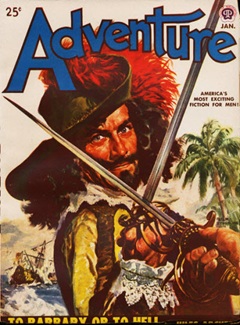
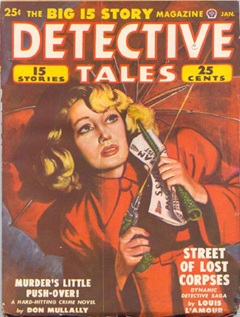
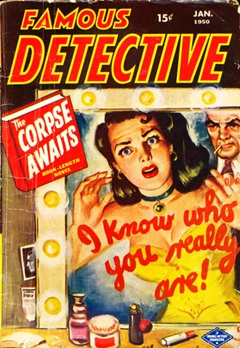
{Airing on a Sunday, the day after New Year’s Eve 1950, most of the neighborhood gang’s parents were recuperating from the previous night’s revelries, meaning if they kept their living room radios at a low sound level, they were free to listen to whichever program they desired. Enjoying this episode, they headed for the nearest newsstand the next day to find more stories of action and adventure. They were not disappointed. Adventure (1910-1971) was born in response to the amazing success of Argosy, which featured a wide variety of fiction–from romance to danger. Argosy was selling in the hundreds of thousands of copies by 1910. But rather than simply copy the same wide spectrum of fiction as Argosy, Adventure chose to narrow its focus to one of “danger and thrills.” While the format proved successful, the publisher decided to gradually morph his magazine in mid-1953 to one unabashedly catering primarily to an adult male audience. With the cover tease line being “The Man’s Magazine of Exciting Fiction and Fact,” the covers (from around 1960 forward) gradually added a scantily clad busty young woman to nearly every cover. Its last year as a monthly was 1950, though its December issue failed to appear. Detective Tales (1935-1953) was the second most successful of Popular Publications detective magazines. Mostly a monthly, it produced a very respectable 202 issues in its 18-year run. It too was a monthly in 1950 but missed its December issue. Famous Detective (1938-1957) featured the 6th of 8 title changes for what began in 1938 as Detective Yarns. After only 3 issues as Famous Detective, its name was changed for the 7th time to Famous Detective Stories. With 8 name changes it fooled (or confused) enough of its readers into believing they were reading a different magazine 8 times in 19 years. It transitioned from a bimonthly to a quarterly in 1950, producing 5 issues. The cover shown below was the last of its bimonthly issues in 1950.}
[Left: Adventure, 1/50 – Center: Detective Tales, 1-50 – Right: Famous Detective, 1/50]
To view the entire list of weekly Old Time Radio episodes at Tangent Online, click here.