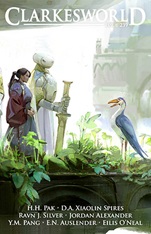
 Clarkesworld #239, August 2026
“As the Tide Loves the Diver, As the Diver Loves the Tide” by Ravn J. Silver
“Passenger Pigeons, Dodos, Neanderthals” by Jordan Alexander
“Feed Them On Your Dreams” by E. N. Auslender
“When You Give a Dokkaebi Taco Tuesday” by H. H. Pak
“All the Ruined Doorways of the Moon” by Eilis O’Neal
“Piece de Resistance” by D.A. Xiaolin Spires
“The Universal Human Happiness Program” by Y. M. Pang
Reviewed by Budd Trippet
The story “As the Tide Loves the Diver, As the Diver Loves the Tide” by Ravn J. Silver, is filled with a water metaphor. Humans are submerged in a chamber and their avatars dive into an ocean of data. There are time shifts and scenes where the divers explore the ‘ocean’ of AI data and where the AI experiences human life. Humanity versus Artificial Intelligence in a story filled with warmth and wonder.
“Passenger Pigeons, Dodos, Neanderthals” by Jordan Alexander is a novelette of evolved humanity on Mars and the slow extinction of life on Earth due to the effects of global warming. Humans left Earth for Mars, built Biodomes for survival and used genetic science to evolve so that they could live in the Mars climate. Teri, an engineer, is transported to Mars by the Endangered Species initiative. He does work that is beneath his skills and is provided with lodging and food by the Martians. He wears an EV suit when working in the Martian environment and forms a friendship with a Martian Xenobiologist named Nile. They have a relationship that starts as friendly but evolves into romance.
Teri receives holographic messages from his mother—she is a biologist who works to keep the remaining Earth animals alive. She sends her son images of extinct creatures, and he tells her that he feels like a Neanderthal. Teri is the first Earth human to be on Mars in 500 years. Humanity on Earth barely survives and most animals have gone extinct.
The descriptions of Mars and the adaptations of evolved humanity are unique and fascinating. Teri meets the only other Earth human, Dunia Amal, who is on Mars. She had failed in her work on Mars and her name is never mentioned on Earth. Teri realizes that he is an example of life that is going extinct. He realizes that Nile is studying him for her doctorate degree and the relationship ends. A commentary on what may happen due to global warming is not didactic and there is beauty and pathos.
“Feed Them on Your Dreams” by E.N. Auslender is a novelette wherein a huge structure is being built around Europa. Much of the construction is done by people, called sailors, who have been conditioned to regard work as their reason for living. After all, humans are cheaper to transport than robots and their parts. The sailors are sterilized as well. One sailor does get pregnant and gives birth to a child that she names Vacule. Vacule is the subject of observation by the Library—a vast AI with almost limitless computing . Vacule’s mother is killed and her body is used as an avatar to the Library. The child is extremely intelligent and learns at a prodigious rate. He is conditioned to remain in one room of the station and is the first human to live on the station. He is an astounding genius and designs the first interspatial drive that would allow travel outside the solar system. He is controlled and conditioned to be afraid of leaving the room, is kept prepubescent and is attached to his ‘mother.’ The theme seems to be toxic capitalism and a society where the wealthy regard all others as property. It is a disturbing satire that made me ponder the story’s end.
“When You Give a Dokkaebi Taco Tuesday” by H.H. Pak is a story based on Korean folklore that occurs in a modern city. A spirit inhabits a broom and that broom can change its form into many shapes. I admit that at first I was puzzled at the spirit who is the narrator of the story, a spirit that can bless or curse a family and its descendants. The spirits join each other at a taco truck. They are all shape shifters. I learned some Korean words and I looked up the meaning of each word after reading the story. A horror fantasy with roots in Korean folklore. H.H. Pak crafts the story with skill.
“All the Ruined Doorways of the Moon” by Eilis O’Neal takes place on the moon and is the story of a woman, Anna, who is married to a wealthy influential man who buys a home on the moon. She is drawn to a folly, a replica of gateways found all over the moon. The gateways were created by another race who have left for places unknown. She seeks a Professor of Extraterrestrial Anthropology who studies those gateways and whose theory is that the gateways were portals. Anna is a poet whose poetry is suppressed as she is suppressed and controlled by her husband Nigel. There is an undercurrent of violence between the couple. Anna desires to finish her degree in Poetry and to be free, though is thwarted by Nigel. The gateways mean escape. Does she escape? Read the story and find out.
“Piece de Resistance” by D.A. Xiaolin Spires is highly entertaining, combining the thrill of heist and the hacking of genres. The dialog is spot on. The technology created by the primary protagonist (unnamed) who is the narrator of the story along with her father, is a force field bubble that can also be a personal force field. A sport known as Zorbing involves going downhill in a force field bubble filled with water. The technology was sold to a corporation because her father was crushed by medical bills. The force bubble and the means to interrupt it are a valuable commodity. The technology becomes a vehicle for omnipresent advertising—in restaurants the meals are concealed in force bubbles that won’t let patrons eat until they watch the ads. This story is a dig at the ever-present ads we encounter in our media, such as where streaming media is only ad free with extra cost to the consumer. The narrator’s mother has been on a downward spiral since the death of her husband and her inability to eat at her favorite restaurant due to her hatred of all the ads. The daughter and her friends devise a plan to ‘borrow’ the devices that create bubbles and can interrupt them. This occurs in a society where there is constant supervision. Our heroine must make herself into a copy of one of the executives and that involves hologram grafting over her skin and replacement eye lenses. She will need all of these plus hacking assistance from her friends to be able to penetrate the corporation disguised as the exec who is on vacation. Tension builds as she infiltrates the corporation in order to access the safe and secure the devices. Identity challenges are myriad. The end result is that the mother can now eat at her favorite restaurant with no bubbles and ads. A fun story and I enjoyed it.
“The Universal Human Happiness Program” by Y.M. Pang visits a future where humanity has been reduced by the disasters caused by global warming. Most are locked into a stasis within a tank that keeps them alive while they rest in a synth fluid; they are the Dreamers. Their minds live in virtual worlds that are partly their creation and partly created by an AI named Hypnos. The Dreamers have caretakers, people who monitor the physical well being of the dreamers and who can enter their dreams and monitor them. Zishun is a Caretaker who witnesses the suicide of one of his Dreamers and acts too late to stop it. He resets the Dreamer, which puts the mind in stasis. Dreamers do die physically either by old age or disease. The youngest Caretaker is Eleri; she had two Dreamers die but was able to give them peaceful death scenarios. Luisa is the Controller and is the Authority over the caretakers. The attraction of the dream state is always present. Zishun is a programmer and he has ideas on how the Dreamers could be awakened and given lives in physical reality. There is a fourth caretaker, Andry, who wants to have all the Dreamers minds put into Hypnos and their physical bodies killed. Zishun writes a code to awaken the Dreamers. It is recorded in a notebook that goes missing but found by him. All personal use of the Caretakers is monitored and assigned by Luisa. The Dreams by Hypnos is the Universal Happiness Program, and its allure makes it irresistible. Eleri wants more time and is blocked by Luisa from Dreaming altogether. The theme here, of virtual reality, is common in many stories, such as the Matrix movies and classic SF. What is real and what is a dream? Are we all the dreams of a being who will cease to exist when the being wakes up?