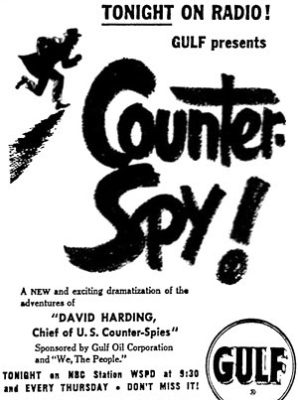
 David Harding, Counter-Spy (1942-57) aired “The Case of the Poison Peddler” on February 24, 1949 as the 345th of its estimated 850 broadcasts, of which only approximately 75 still exist.
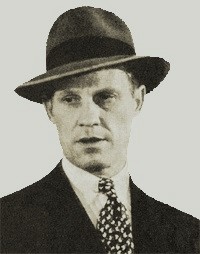
We showcased our first episode of this fine program in March of 2023, over 3 years ago, and quickly followed it with another in September of that year. Our third came in March of 2024, with the fourth coming a year and a half ago in February of 2025, so a brief recap of the show is in order. The creative genius behind Counter-Spy (retitled in 1946 to David Harding, Counter-Spy at the insistence of a new sponsor) was Phillips H. Lord (1902-1975, photo below left). Lord was highly respected in radio circles, having produced such popular programs as Gang Busters (1935-57), Mr. District Attorney (1939-53), and the patriotic series We, the People. When the United States entered world War II following the December 7, 1941 sneak attack on Pearl Harbor, Hawaii, Lord took notice that there were few true espionage programs on the air and decided to rectify the situation by creating Counter-Spy. Many of the stories were based on factual cases Lord had been given access to for use in his previous crime programs, but whose stories were of course dramatized, fictionalized accounts that proved popular with an anxious audience starved and ready for such Good Guys vs. Bad Guys espionage stories with the war at the forefront of their minds. Lord himself was no stranger to spy work, having been a confidential but official agent in secret counter intelligence work for four years before the war broke out.
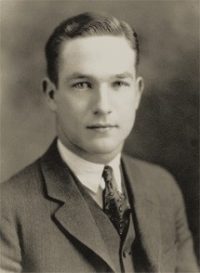
One aspect that brought the war closer to home was that Counter-Spy stories took place in, or close to the United States rather than abroad, with the first few years before the war ended devoted to tales with Lord’s fictional counter-spy, David Harding, and his assistant counter-spy Harry Peters (played by Mandel Kramer) dealing with Germany’s Gestapo and Japan’s Black Dragon spy agencies working clandestinely within the United States. Harding was special in that he was pretty much his own boss, with free-reign over what and how he handled sensitive cases while working with various government departments when his cases happened to cross into their individual jurisdictions. Don MacLaughlin (1906-86, photo top right) was cast as David Harding, his title being loosely interpreted as the head of the United States Counterspies Unit; one might legitimately say he was the Chief Counterspy of this “imaginary” unit. Like Lord, MacLaughlin was no newcomer to radio, having proved himself with his versatility in a number of prior action and dramatic productions. In truth, MacLaughlin had performed in, according to one source, “some 300 roles” since his radio debut in 1935. MacLaughlin secured the permanent role of Harding after the third episode, beating out some 20 others for the top spot. The Lord and MacLaughlin team turned out to be a match made in heaven, for MacLaughlin kept the role for the next 12 years. After the show ended in 1957, MacLaughlin began a new stage in his acting career as, for 30 years, he played attorney Chris Hughes on the daytime soap opera As the World Turns, until his death in 1986. Much interesting background could be added to this necessarily brief introduction to this one of a kind patriotic war time program, but suffice to say it became so popular so quickly that within a year it was so well-received that it took no summer hiatus, and for some of its future programming would be nominated for a Peabody Award and receive “numerous citations from local and civic groups throughout the 1940s.” Aside from a brief period of time (January 1949-August 1950) when it aired twice a week with Pepsi-Cola as the sponsor, David Harding, Counter-Spy was a weekly broadcast throughout its run.

This episode, as the title implies, deals with those who peddle one of the worst poisons of all to our youth, but it is not a poison of the kind that may come readily to mind, but the insidious poison of bigotry and race hatred peddled and sold to the most vulnerable and impressionable of all, those who cannot see behind the silver tongued promises of race baiters, skilled in turning one race, or group of people against another—and only asking for a few dollars from those willing to belong to their group, a group that makes the alienated young feel welcome. This story focuses on a group of race baiters calling themselves the Young Defenders, and how they twist facts and the truth by skillfully playing on the emotions and idealism of the young generations who know no better and who are easy prey for the ultimate in political gaslighting. It is hard when listening to this episode not to make comparisons with the bigots and haters of today who use the very same tried and true tactics to turn the younger yet educated of our next generation into haters of democracy in favor of socialism–though now they are exposed to and learn from the very educational institutions which have in the past served as beacons of free speech but now serve to twist our history and make enemies of this or that group (blacks, Jews, white supremacy/white males, Christians, etc.), or any group that will serve their political agenda and keep the contributions coming from the willing and politically naive. This episode is a wonderful time capsule in two ways: it shows how bigotry and race hatred is still used as a means to enhance the coffers of those who value money above any moral standard, and perhaps even more starkly it reveals that in this episode and this time in America’s history, such things as what goes on here are considered a crime, the crime being that of inciting hate against ignorant people and capitalizing on it for the sole purpose of making money; quite a racket. So listen now as David Harding as a counterspy seeks to save one young boy from the influence of the Young Defenders and close down that ring of racketeers and the subversive influence it has on the youth of America, in “The Case of the Poison Peddler.”
Play Time: 29:20
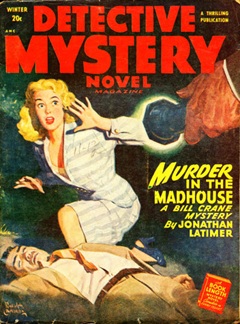
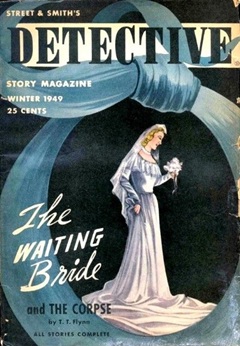
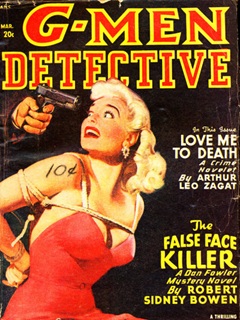
{Airing on a Thursday in late February of 1949 meant that the neighborhood gang would be heading for the close by newsstand after school the next day, a Friday, when they would stock up on their favorite reading material with enough to last them over the weekend. Detective Mystery Novel (1935-51) was a quarterly in 1949 though it managed only 3 issues. Street & Smith’s Detective Story (1915-53) was the first pulp devoted to detective fiction. Through 1935 it held to an amazing bi-weekly schedule, then from 1936 through 1948 it switched to a mere monthly schedule with 1949 being its first quarterly offering though it managed but 3 of its projected 4 issues. G-Men Detective (1935-53) quickly found it audience and at first was titled only as G-Men, but in 1940 added Detective to its title as interest in federal agent crime stories began to wane. It was a bi-monthly in 1949 but produced only 5 of its 6 projected issues.}
[Left: Det. Mystery Novel, Winter/49 – Center: Det. Story, Winter/49 – Right: G-Men Det., 3/49]
To view the entire list of weekly Old Time Radio episodes at Tangent Online, click here.